
Turning the dials

Whatever we might think of the reliability and validity of judgements, there are some ultimate indicators that a school has improved. An up levelling of the inspection grade. Growth through an increased number on roll. An increase in the proportion of children achieving a given standard in statutory assessments. Staff retention. An increase in attendance. Fewer incidents of poor behaviour. Matthew Evans suggests that we are drawn to these objects of school improvement; imagining that there are certain levers that we can pull to bring about those improvements as if our school were a merely complicated system, not a complex one.
It is tempting to believe that if we just pull the curriculum lever, we’ll get better results. If we just pull the behaviour lever, we’ll get fewer incidents. If we just pull the quality assurance lever, we can really drive up standards. If we just pull the wellbeing lever, we’ll retain more teachers. There are however no simple cause and effect relationships in complex school systems. So if we want a better inspection grade, or higher results, or better behaviour, or more staff wellbeing, we’ll probably try pulling multiple levers. Our school improvement plan then becomes a monstrous, 20 page document that outlines every single thing we aim to improve over a short period of time (often within the next inspection or results cycle) and exactly how we’ll do it with actions allocated to colleagues and our finger hovering over the color fill, ready to RAG rate each one when someone higher up comes knocking.
Maybe we should pull some levers harder than others then. Let’s pull the uniform lever really hard, as far as it will go. But we’ll only pull the homework lever a little bit. That might help us to reduce our priorities down to a manageable number and maybe avoid the massive impending cognitive overload of staff.
These are examples still of the school as a complicated system, not a complex one. When we pull the teaching lever, or the parental engagement lever, or the marking lever, they won’t just have an effect on the thing that we might want it to, but on all sorts of other things, some of which we might be able to predict and some of which we absolutely cannot.
Let’s switch this metaphor from levers to dials. Now, let’s imagine that for each of those objects of school improvement (curriculum, behaviour, wellbeing, attendance etc) there exists a dial. Moment by moment, the dials are moving because of the innumerable complex interactions between staff, children and the community. Let’s imagine that we can turn each dial up and, even if just momentarily, make that object ‘better’. But all the dials are connected. By turning up the behaviour dial, we might see an improvement in behaviour and that could also nudge the results dial higher, and the wellbeing one. But it might nudge the parent satisfaction dial down a bit. Let’s say we turn the curriculum dial up and our curriculum is objectively more intelligently sequenced. This might not nudge the results dial at all! And it might even nudge the teacher wellbeing dial down because of the increased workload of resourcing a revamped curriculum. Big turns of the the dial might result in big turns (in both ways) on other dials, or small ones. And vice versa.
School leadership can be like watching these dials, fiddling with each to see the effect and then fiddling some more.
Improvement vs maintenance
So what does the work of improvement look like? I’m starting to think of it as two broad organising concepts. Improvement vs maintenance. To continue with the dial metaphor, we want to make sure that no dial turns below a given point. And how do we do that? By designing, implementing and maintaining systems. It might be a behaviour strategy. Or the way that teams plan together. Or a routine for team teaching. Any set of behaviours that are well known, habitual and carried out by everyone almost autonomously. After all, as James Clear argues:
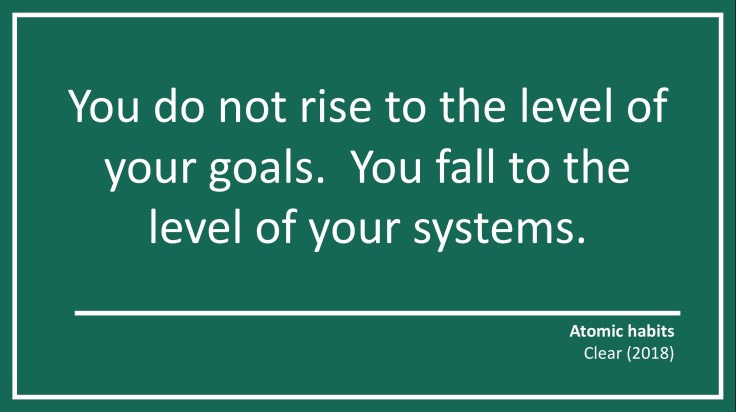
So one part of school leadership is system maintenance, making sure that none of the dials slip below a given point. We might be carefully watching for a dip and then turning back to where it should be. When that has a knock on affect on other dials, we do the same.
But we’ll also want to seek improvement; deliberately turning dials up. If we track this metaphor back to reality, what is the leadership work of turning a dial up? As Matthew Evans argues, and I wholeheartedly agree, there can be no school improvement, no improvement in any of those objects, without greater staff expertise. And how do we increase staff expertise? By setting our school up to prioritise adult learning. This can’t be controlled as much as we might like to think, through the standard INSET days and twilight training sessions. There is far more to it. Turning the dial is creating opportunties to collaborate. Turing the dial is organising learning materials, making them easily accessible and readily available. Turning the dial is clarifying our specific strategies. Turning the dial is deliberately forging a shared langauge to talk about what we do each day. Turning the dial is story telling of our successes to drive behaviour each day.
Turning a dial then is about shaping the conditions in which better work becomes more likely. It is about reducing friction and creating the space in which professional expertise can grow.
This is why so many school improvement efforts feel busy but brittle. We spend huge amounts of energy adjusting dials that are constantly being knocked out of place by the system itself. We monitor, correct, reassure, remind and intervene. The work never finishes because the underlying conditions never change. Real improvement begins when we stop asking people to compensate for what the system has not been designed to hold.
That means investing less energy in pulling levers and more attention on building routines, shared practices and learning structures that stabilise the dials in the first place. It means accepting that coherence is not created through urgency or enforcement but through thoughtful design and sustained learning. Schools do not improve because leaders turn the right dial at the right moment. They improve when the everyday work of teaching and learning becomes easier to do well, more likely to happen and less dependent on individual heroics.
I really related to the idea of “pulling levers” and the overwhelm that comes when a school is trying to pull too many at once.
I appreciate your focus on the importance of creating conditions where teaching and learning can become ‘easier to do well, more likely to happen, and less dependent on individual heroics’. So true.
Thanks for a great read, Nick.