
Creating adaptive space


The adaptability imperative
Complexity doesn’t pause for us to catch up. Schools, like all organisations, operate in shifting environments. Policies, technologies and expectations evolve in parallel, often unpredictably. The question for leadership is not only how to manage change but how to sustain adaptability. Two papers are worth reading here. Uhl Bien and Arena’s piece on organisational adaptability and Schulze and Pinkow’s piece on adaptive space.
Adaptability is a capability of the organisation itself, the way it continually transforms its own knowledge, routines and relationships in response to context. For schools, that means adaptability is a property of how the community thinks and works together.
The architecture of adaptive space
Uhl-Bien and Arena describe adaptive space as the arena where an organisation’s two systems (the entrepreneurial and the operational) meet. Adaptive space is where both functions coexist, where new ideas are tested, connected and, when ready, absorbed into the operational core.
For school leaders, this reframes improvement. Schools don’t evolve because a leader writes a new strategy. They evolve when professional knowledge is continually reconfigured through interaction, when ideas about assessment, curriculum, or pedagogy are shared, tested, and adapted until they work in context. Adaptive space is where that translation happens.
Conflicting and Connecting
Uhl-Bien and Arena describe adaptive space as a place of conflicting and connecting. Conflicting creates the energy for change; friction between the new and the established. Connecting allows those ideas to flow across boundaries and into the formal system. Both are necessary.
In schools, this can look like a leadership team holding space for disagreement about curriculum models while ensuring that those conversations remain connected to the classroom. When leaders over-manage conflict, the energy dissipates; when they ignore it, innovation fragments. Adaptive leadership is the discipline of holding the tension long enough for something better to form. Lencioni talks about the value of conflict as a productive team behaviour, not interpersonal but around ideas.
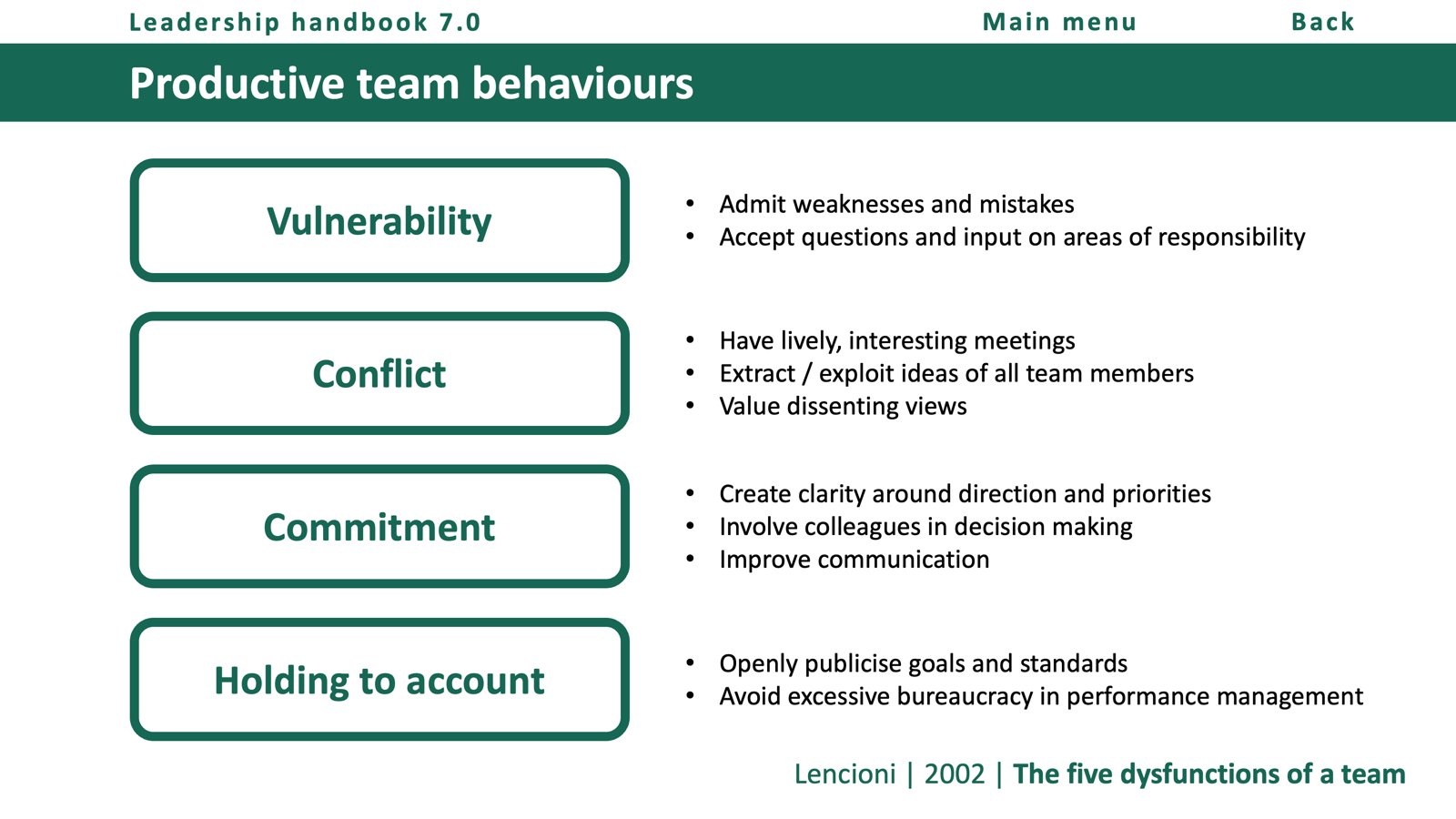
The role of the leader in creating conflict around ideas is crucial. Absolute truth can easily be assumed when someone with status make a claim about what is valuable or what is right. Lack of challenge of ideas stunts adaptability.
To see how adaptive space operates in reality, consider a familiar challenge: redesigning a school’s assessment system. A team is tasked with identifying key performance indicators to help teachers make reliable judgements of attainment. Initially, they produce a long list. Tension rises; what stays, what goes? Who decides? Instead of resolving the disagreement, leaders introduce boundaries:
Threshold concepts | KPIs should focus on concepts that transform understanding
Recurrence | KPIs should be encountered often in the curriculum to encourage curriculum adaptation
Weighting | KPIs should reflect what we value in the curriculum
Criticality | If we’re copying and pasting statements from the national curriculum, we’re not thinking hard enough
Assumptions | Hierarchical knowledge structures means we don’t have to repeat some KPIs year on year
The team now has a way of making decisions, not just a task of identifying KPIs. The adaptive space created becomes a leadership development opportunity to learn some curriculum and assessment concepts while getting the work done which helps the team think and communicate differently about the task.
Networks
Adaptive space depends on networks. Innovation travels through informal relationships long before it appears in documents. Leaders who understand this pay as much attention to the pattern of interaction as to the structure on paper. Networks are the circulatory system of adaptability. They carry insight, feedback and small experiments between people who see the organisation from different angles. In schools, this might mean connecting teachers across phases, linking subject specialists with pastoral leads, or building partnerships between classrooms that face similar challenges. Each interaction is a potential bridge between the entrepreneurial and operational systems.
Creating adaptive space in schools
Schulze and Pinkow’s study of adaptive organisations found that the conditions for innovation are deliberately designed. Enabling leaders create what they call adaptive space: settings where people have the permission, time and relationships to explore ideas before those ideas meet the formal system. In schools, that design work sits with leaders. It lives in the daily structures and routines that either expand or contract teachers’ capacity to think together; how we use time, how we meet, how we talk.
Time as headspace
Every example of adaptive space began with time to think. For school leaders, this finding reframes how we treat time: it’s a leadership resource. Creating headspace means protecting thinking time during improvement phases, reducing administratively heavy meetings, and signalling that reflection is part of professional responsibility.
Physical and virtual space
Enabling leaders also shape where interaction happens. Adaptive space can exist in a shared planning room, a corridor conversation or an online workspace. What matters is the flow of ideas across boundaries. Teaching is often isolated; timetables and physical layouts can limit collaboration. Leaders who understand this can design deliberate points of connection; co-planning sessions, cross-year curriculum reviews, shared digital folders that make thinking visible. These are structural signals that dialogue matters.
Meetings as adaptive infrastructure
Meetings were one of the most consistent adaptive spaces in the study. For schools, that’s both a challenge and an opportunity. Are our meetings designed for adaptation? A well-crafted agenda that makes space for interpreting data, surfacing tension and testing meaning turns meetings into arenas for sense making. Leaders can treat every meeting as a design choice: is this space helping people to explore and connect, or merely to comply?
Adaptive leadership
Both studies point to the same truth from different angles. Uhl-Bien and Arena show that adaptability depends on the continual movement between innovation and operation; conflicting and connecting until a new order takes shape. Schulze and Pinkow remind us that this movement needs design: time to think, places to meet. When leaders combine both views, they turn everyday structures into engines of adaptability.
For school leaders, the task is to make this visible and habitual. Protect time as a resource for reflection. Shape meetings and spaces as platforms for learning. Offer decision making frameworks to guide improvement work. Pay attention to the networks that carry ideas across boundaries. Adaptive space is where a school’s future quietly forms through the flow of conversation, the courage to test, and the discipline to stay connected long enough for new ideas to take root.