
Curiosity
One of the six sense making disciplines

In Leadership, Rewritten, Richard Claydon argues that flexibility in teams is sustained through disciplined repetition. When stabilising work is maintained, systems retain range. When it is neglected under pressure, strain accumulates and fragmentation follows.
The six disciplines are the same six that Richard identifies: clarity, coherence, connection, collaboration, cooperation and curiosity. If clarity establishes focus, coherence sustains alignment, connection strengthens trust, collaboration expands thinking and cooperation enables coordinated action, curiosity renews collective judgement.
Curiosity shapes how teams remain open to revision. Without it, systems become efficient but intellectually closed.
Curiosity is the sixth of the six sense-making disciplines.
Curiosity
In schools, the absence of curiosity appears as:
confidence that feels settled too quickly
explanations repeated without re-examination
data interpreted through familiar narratives
dissent framed as disruption
Curiosity is produced through deliberate intellectual humility, exercised repeatedly and made visible to others. In complex systems, leaders cannot prevent uncertainty, but they can prevent premature certainty. The curiosity discipline contains core strategies that protect interpretive range.
Ask: What have we missed?
Closure is tempting. Leaders practising curiosity deliberately reopen the frame before finalising decisions. They invite consideration of blind spots, unintended consequences and overlooked data. When this question is absent, confidence hardens into assumption. Asking what has been missed does not delay action indefinitely; it strengthens it.
In practice
Before concluding, ask what perspectives are absent
Identify risks not yet discussed
Invite dissent before formalising agreement
Surface the assumptions
Every decision rests on hidden premises. Leaders practising this strategy make those premises explicit. They ask what must be true for the chosen course of action to succeed. When assumptions remain invisible, disagreement becomes personal rather than analytical. Surfacing assumptions shifts debate from position to reasoning.
In practice
Ask, ‘What are we assuming here?’
Identify conditions required for success
Test assumptions against available evidence
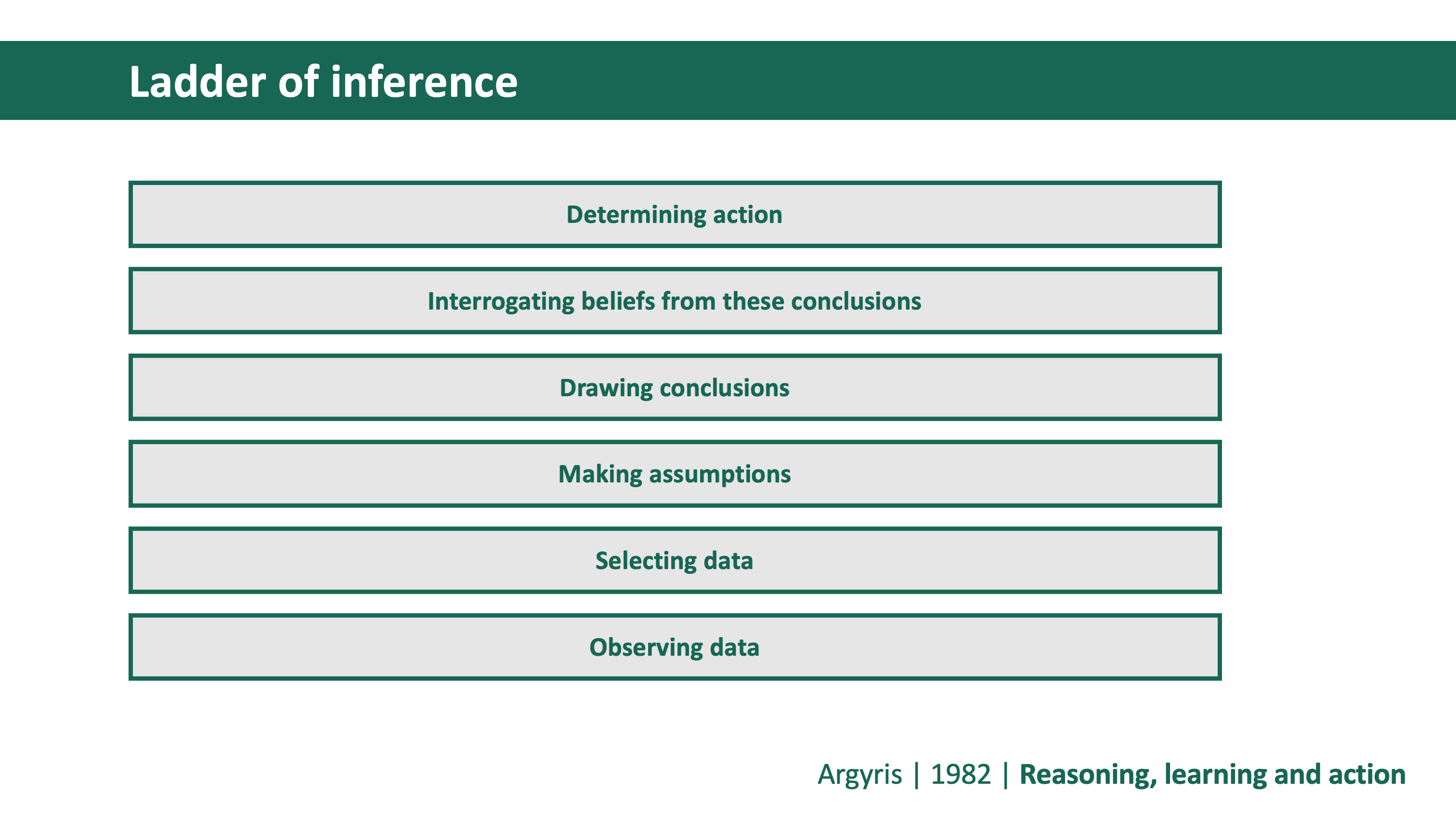
Ladder of inference
Interpretation moves quickly from observation to conclusion. Leaders practising curiosity slow this movement. They examine how data was selected, how meaning was assigned and how conclusions were drawn. Without awareness of inference, narratives solidify prematurely. The ladder of inference restores transparency to reasoning.
In practice
Distinguish between observed facts and interpretation
Trace how a conclusion was reached
Invite alternative readings of the same data
Get more perspectives
Homogeneous interpretation narrows possibility. Leaders practising curiosity actively seek viewpoints beyond the immediate group. They consult those with different experience, expertise or positionality. When perspective remains closed, blind spots persist. Expanding perspective strengthens adaptability.
In practice
Consult colleagues outside the immediate team
Invite feedback from those affected by decisions
Draw on research or external evidence to challenge internal consensus
Why these strategies matter
These curiosity strategies perform intellectual work. They prevent stagnation and protect against overconfidence. When curiosity is weak, leaders experience repeated surprises, entrenched positions and defensive reasoning. Decisions may be coherent and well coordinated, yet increasingly detached from changing reality. Curiosity sustains adaptability over time.
How to use the curiosity strategies
These strategies are most useful when agreement feels comfortable, when explanations are repeated unexamined, or when dissent is minimised. They are not abstract reflective exercises to conduct occasionally; they are intellectual habits that keep systems open to learning. Their phrasing is intentionally simple. They are designed to interrupt closure.
Used well, they:
widen interpretive space
strengthen the quality of judgement
reduce the risk of overconfidence
Practical guidance
Model intellectual humility publicly
Separate questioning from criticism
Build reflection into existing decision cycles
Treat dissent as data rather than threat
Curiosity does not undermine clarity or coherence. It protects them from ossifying.
Clarity establishes focus.
Coherence sustains alignment.
Connection strengthens trust.
Collaboration expands thinking.
Cooperation enables coordinated action.
Curiosity renews collective judgement.
Together, these six disciplines create stability with range; disciplined repetition that enables adaptability rather than brittleness.