
Coherence
One of the six sense making disciplines

In Leadership, Rewritten, Richard Claydon argues that flexibility in teams is sustained through disciplined repetition. When stabilising work is maintained, systems retain range. When it is neglected under pressure, strain accumulates and fragmentation follows.
The six disciplines are the same six that Richard identifies: clarity, coherence, connection, collaboration, cooperation and curiosity. If clarity reduces ambiguity about direction, coherence reduces fragmentation across time, teams and decisions. Rather than treating problems as isolated events, the coherence discipline shapes how leaders connect actions to patterns and decisions to structures. It strengthens alignment so that collective work does not drift into disconnected activity.
Coherence is the second of the six sense making disciplines.
Coherence
In schools, incoherence can accumulate through small disconnections:
initiatives misaligned with strategy
policies that operate on different assumptions
improvements that solve one issue while creating strain elsewhere
the natural emergence of new ideas by well meaning people
Coherence is produced through deliberate acts of interpretation, exercised repeatedly and made visible to others. In complex systems, leaders cannot control every variable but they can widen the frame within which problems are understood. The coherence discipline contains core strategies that shape how work is connected across time and system boundaries.
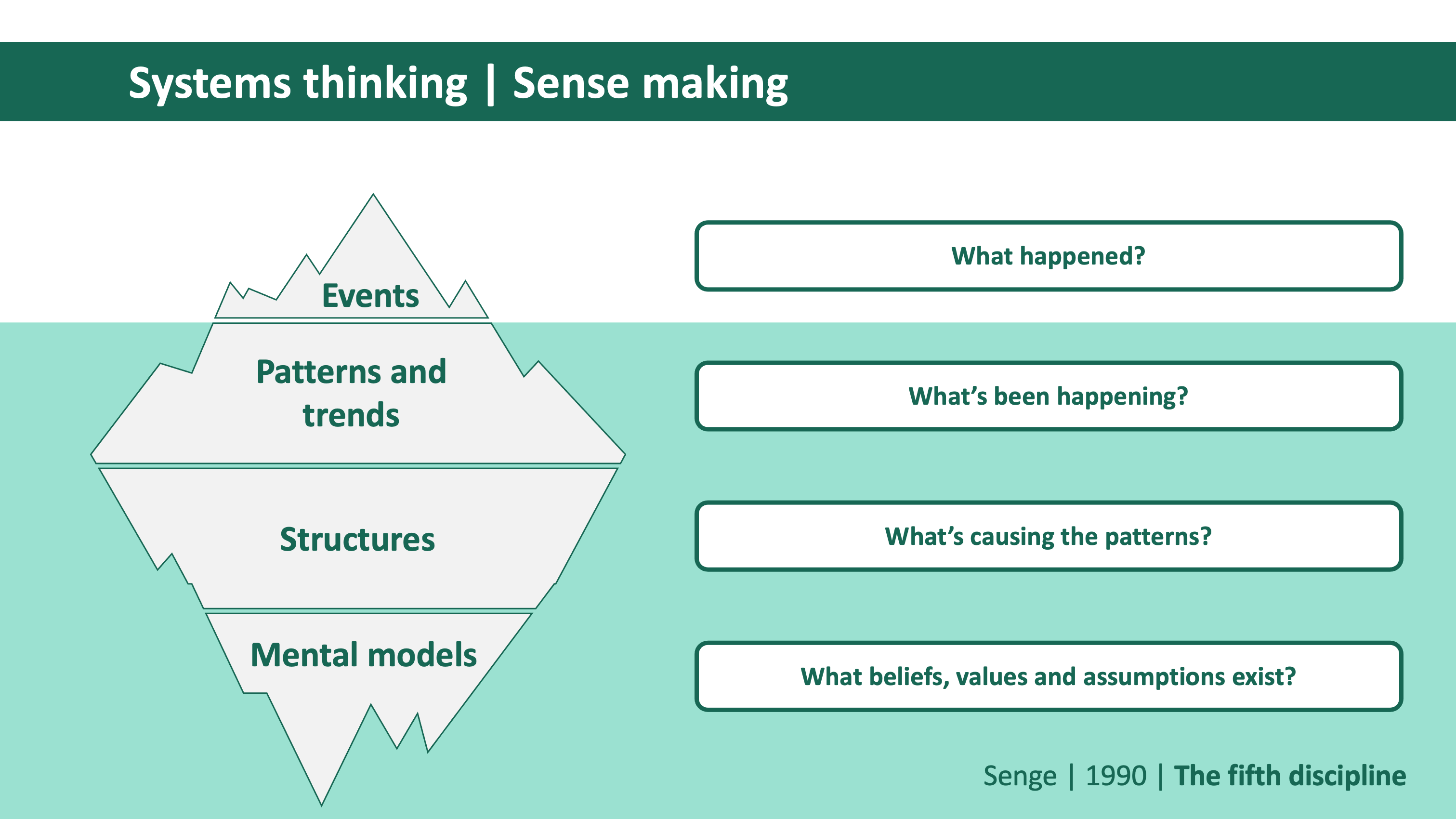
Iceberg systems thinking
Ask: How is this related?
Backtrack from actions to beliefs
Map second order consequences
Iceberg systems thinking
Leaders practising coherence move conversation beyond incidents to patterns, structures and underlying assumptions. They distinguish between what happened and what has been happening. Often, today’s problems are the result of yesterday’s solutions. Quick fixes relieve pressure in the short term but can generate unintended consequences that reappear later in altered form. When teams remain at the level of events, they solve repeatedly without learning. The iceberg model is a discipline of attention that nudges us into exploring deeper causes of phenomena.
In practice
Work down the iceberg together, exploring deeper connections
Get the right people in the room to see problems from different perspectives
Make structural causes discussable rather than personal
Ask: How is this related?
Fragmentation often begins with treating decisions as independent. Leaders practising coherence routinely ask how a new proposal, issue or idea connects to existing priorities and structures. Work that is not integrated at the point of decision must be reconciled later, often at greater cost. Over time, this discipline builds an expectation that new work must connect to existing direction.
In practice
Before approving new work, ask what it links to
Map proposals against current strategic priorities
Treat disconnected initiatives as risks to coherence, workload and culture
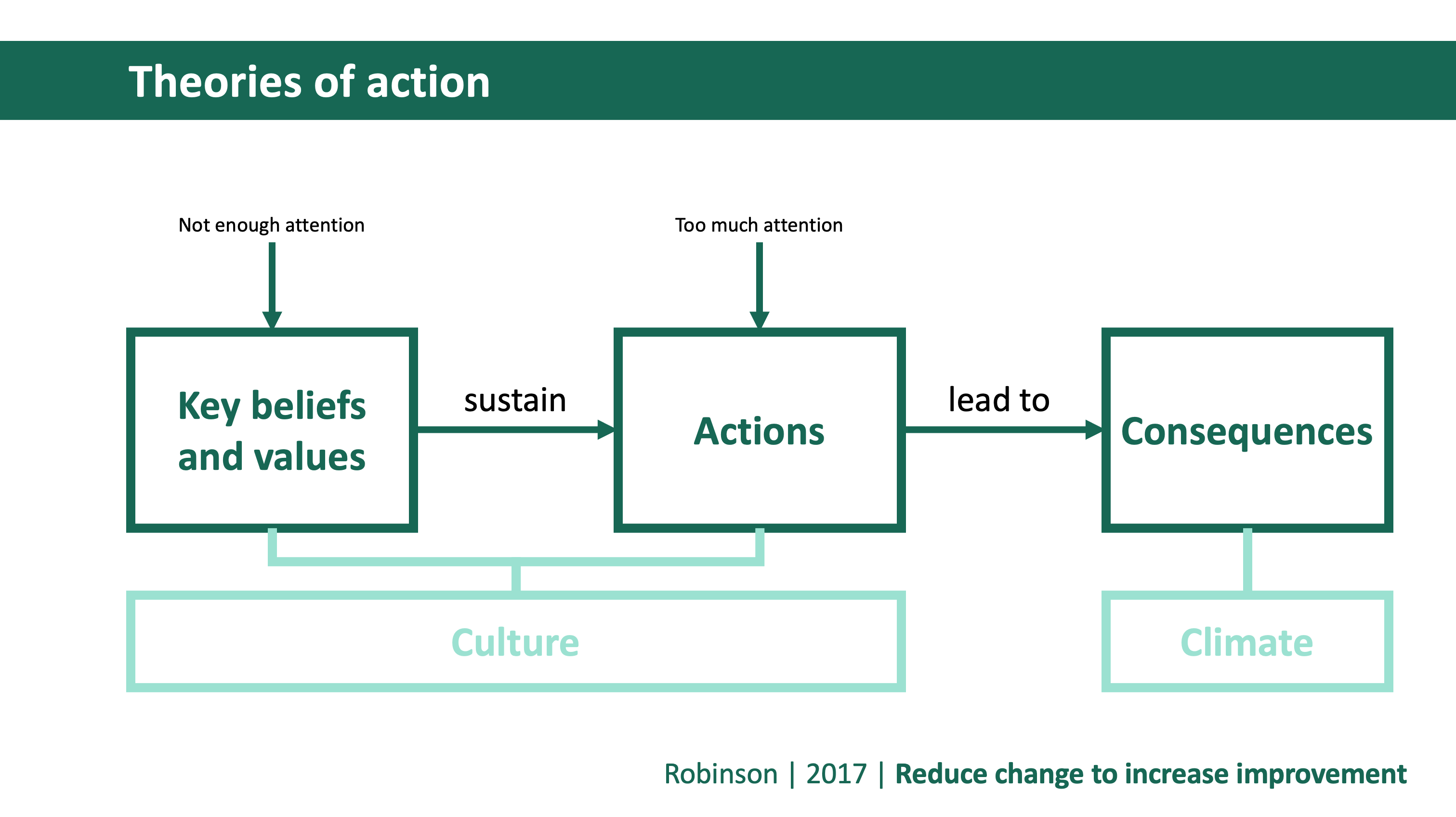
Backtrack from actions to beliefs
Actions are shaped by assumptions, often implicit. Coherence deepens when leaders trace behaviour back to the beliefs that generate it. If a team responds in a predictable way, there is usually an underlying logic guiding that response. Surfacing that logic makes disagreement analytical rather than personal. In systemic terms, there is no blame; patterns of behaviour are often produced by structures and assumptions rather than individual intent.
In practice
When tensions arise, ask why we think what we think
Reconnect decisions to stated values and principles
If considering asking teachers to do a specific thing, discuss what beliefs would enable or inhabit that action
Map second order consequences
In complex systems, cause and effect are not closely related in time and space. Leaders practising coherence consider how decisions will interact with other parts of the system and how effects might emerge later and elsewhere. They ask who else will feel the impact and what new tensions might surface. Improvement can stall when growth is not matched by investment or when limiting factors are ignored. Without this discipline, teams repeat cycles of ‘fixes that fail’ and shifting the burden to short term relief.
In practice
Ask ‘Who else will be affected by this decision?’
Ask: ‘How might this idea be misinterpreted?’
Test ideas with others. Ask the person you know will disagree.
Carry out a pre mortem.
Why these strategies matter
These coherence strategies perform integrative work. They prevent actions from detaching from structures and protect strategic intent from erosion through isolated decision making. When coherence is weak, leaders experience repeated rework. The same categories of problem recur. Standards drift. Energy is spent correcting the unintended consequences of earlier solutions. Coherence enables learning to compound rather than reset.
How to use the coherence strategies
These strategies are most useful when activity is high but alignment feels thin; when teams are solving quickly but patterns are repeating. They are not analytical exercises to be scheduled occasionally; they are interpretive habits that widen the frame of discussion. Their phrasing is intentionally probing, designed to interrupt narrow problem solving and reconnect decisions to structures.
Used well, they:
slow premature solution building
connect decisions across teams and time
expose assumptions that drive repeated dynamics
Practical guidance
Treat them as leader prompts, not discussion topics in their own right
Introduce them explicitly, then model them until they become shared language
Pay attention to when they are most needed: moments of fragmention
Clarity does not come from better plans that one person has written, it comes from leaders repeatedly shaping how the team makes sense in everyday work.
Each of the six disciplines builds on the previous one: clarity establishes focus. Coherence sustains alignment. In the next post, I’ll explore the connection discipline and strategies that strengthen the relational conditions within which collective sense-making can occur.
Interesting explorations, which I find very thought-provoking. I'm curious, as I can't find these 6 disciplines in any of Richard's posts, could you provide a direct link to his writing about them? Thank you!