
Treating the complex as complicated

Two things have made me further question the logic of school improvement plans recently. The first is this comment from Kev Bartle:


And the second is reading this paper on adaptive expertise by Helen Timperley. One of Timperley’s points exemplified in the paper is that it is easy to treat complex problems as merely complicated. Here she is on the distinction between the two:
Complicated problems require higher order expertise but their defining features are that causes are reasonably easy to identify and adequate solutions are known. Once learned, reasonably predictable results can be expected. The parts add up to the whole, so each part can be analysed and learned separately, then combined into a solution.
Most challenges faced by school principals and leadership teams, however, are complex. They are characterised by interactions and interdependencies and often come together in unpredictable ways. They are often hard to define, with multiple causes and contested solutions.
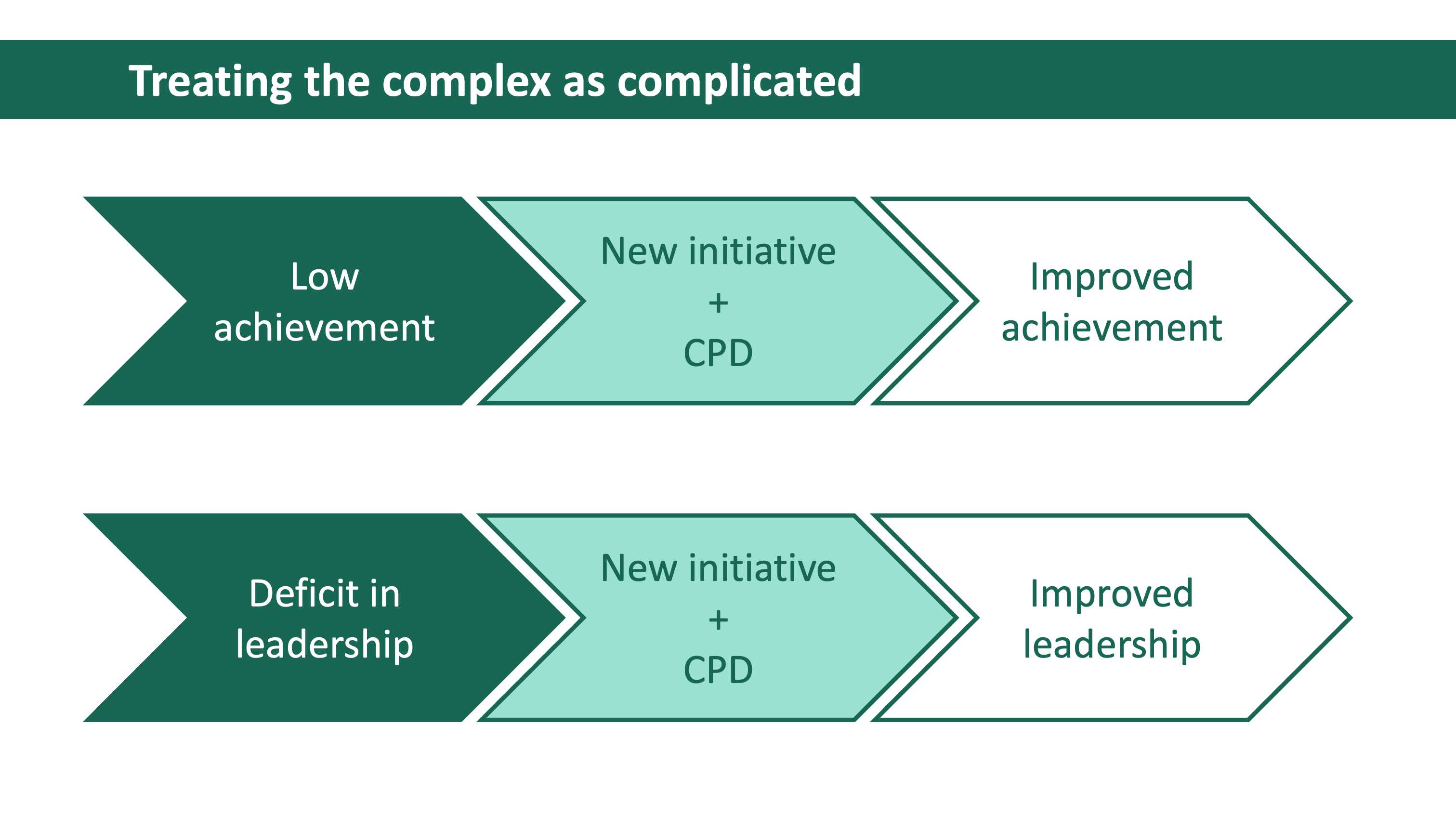
How do we typically try to improve our schools? We’d identify areas of school life (usually three!) that require our attention for a period of time (usually a year or three). We set a measurable target, map out some actions and then get on with the planned work. This is a pretty good example of treating the complex as if it were complicated. It assumes causes of problems that are reasonably easy to identify; it assumes known adequate solutions; it suggests the expectation of reasonably predictable results; and it suggests that school improvement as a whole might be split into parts that are analysed and addressed separately. Timperley describes a problem with this:
It is well established that as the number of initiatives in a school goes up, motivation and impact are likely to go down (Bryk, Gomez, Grunow & LeMahieu, 2015; Reio & Lasky, 2017). Rather than improve outcomes for students, the most likely impact is overwhelmed teachers, who become de-motivated over time in relation to the whole school agenda and focus on their own personal professional learning because they are not given the opportunity to delve sufficiently deeply into any one focus area as they try to do everything (Le Fevre et al., 2020). They do not get to experience the positive motivation associated with accelerated student learning as a result of new ways of doing things (Timperley et al., 2007).
3 reasons for treating the complex as complicated
What might be causing us to treat the complex as complicated in (variations) of this way? I think there are several. One is collective understanding of how schools improve. The approach described above is, I imagine, incredibly common if not ubiquitous. When current leaders cut their teeth under the tutelage of leaders before them, they pick up received wisdom about how to go about the work. And there are plenty of successful schools out there where leaders may well attribute success to their (complicated) approach to school improvement.
A second reason might be the accountability system that we work within. Those in charge of governance hold us to account for what we are doing to improve our schools. Tangible artefacts such as school improvement priorities that seek to address perceived weakness and the associated RAG rated action plans might give some sort of reassurance that leaders are acting. When there is urgency to improve, the busyness of such complicated school improvement can be the thing that provides reassurance to ourselves or to others that we’re doing our job.
A third reason for why we engage in complicated school improvement is because of the limitations of ego development. Neil Gilbride argues that the stage of a leader’s ego development affects what they are aware of and can describe, reflect upon and do. Pertinent here is our understanding of complexity, which develops at each stage of ego development. Of the three most common stages of ego development in headteachers and principals, appreciation of complexity looks like this:
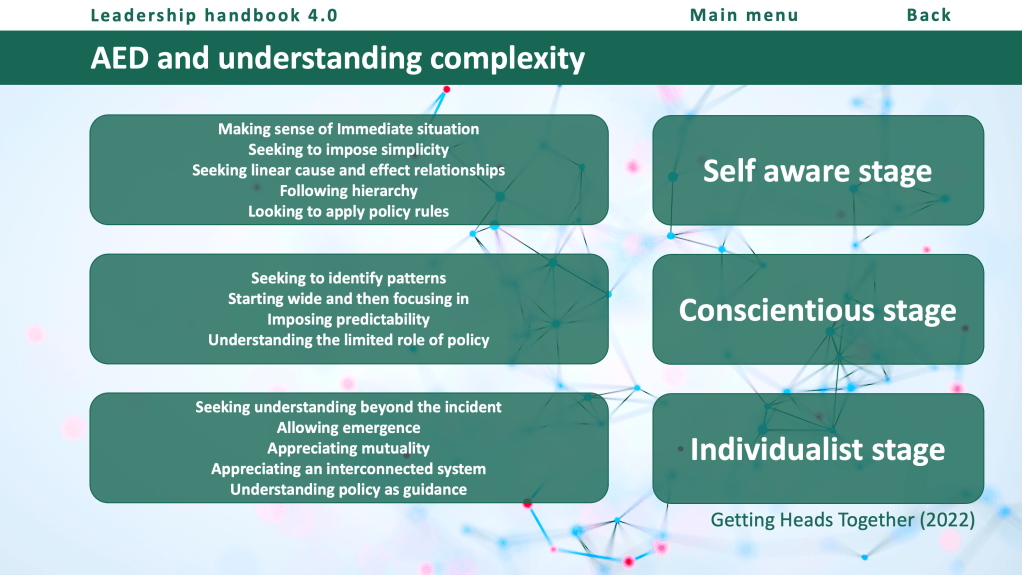
I would argue that complicated school improvement thinking sits squarely in the self aware stage of ego development.
Treating the complex as complex
Is treating the complex as complicated a problem that needs to be addressed? If there are as yet untapped ways in which to further improve education, then it is surely worth pursuing. Now given the nature of complexity, it is quite likely that the suggestion that comes from this post is a continuation of complicated thinking as opposed to complex. There may be some value in taking Timperley’s concept of adaptive expertise further though:
One could argue that an approach to school improvement that is more appreciative of complexity first considers some fundamental, interconnected truths. For me, these are:
There can be no improvement without high levels of trust
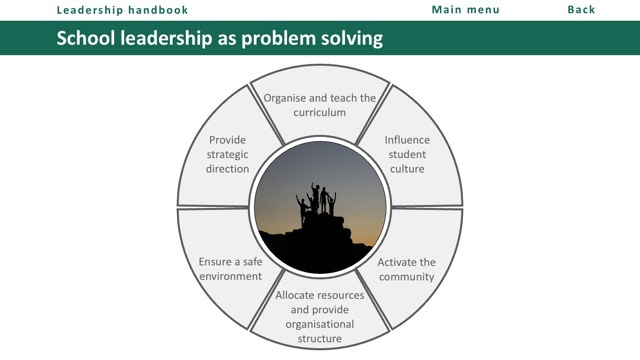
School leadership is problem solving
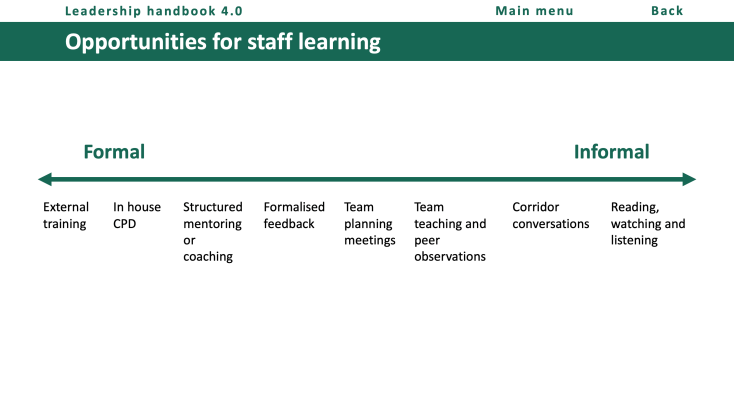
There can be no improvement in student achievement without first improvement in colleagues’ expertise
Trust, problem solving and professional learning; very much interconnected concepts that are at the heart of any school improvement. Perhaps it is these things that must be the focus of principals’ attention:
Trust
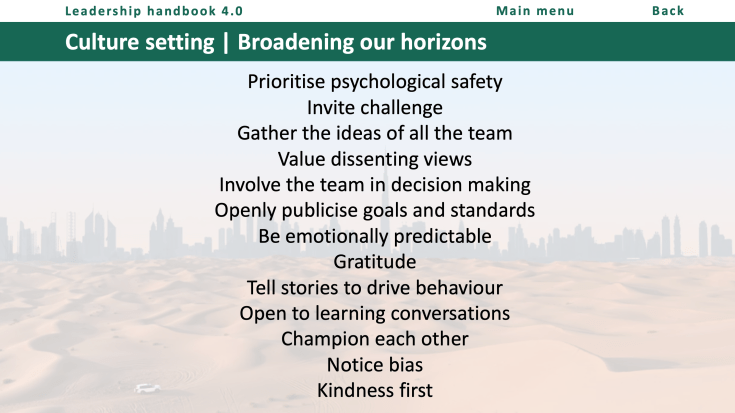
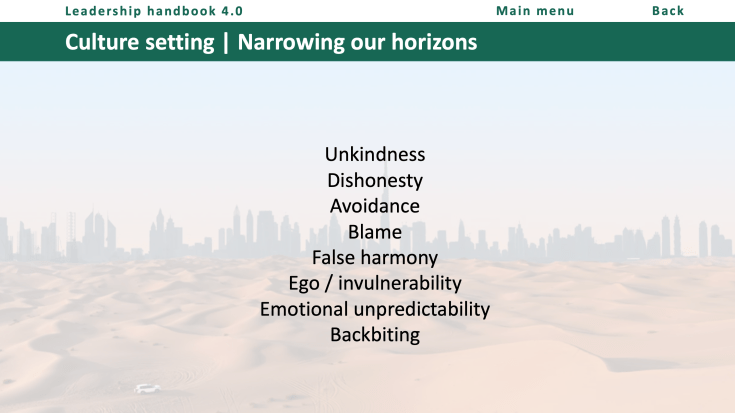
Problem solving
Professional learning
Avoiding the trap of genericism
At first glance, a principal who focuses their improvement efforts on trust, problem solving and professional learning could be challenged on focusing on generic approaches. As concepts, they could apply just as much to a hospital as an airport or a restaurant as they do to a school. However, it is domain specific knowledge that provides the substance of building trust, solving problems and supporting others’ learning. After all, a significant factor in trust dynamics is competence; problem solving requires a great deal of domain specific knowledge; and effective professional learning helps participants to build knowledge.
So perhaps we need to rethink the strategic focus for leaders at different levels. Maybe the principal, through the school improvement plan, focuses their attention on building relational trust throughout the school, supporting other leaders to solve problems and making sure that the organisation is optimised for professional learning. And maybe it is middle leaders such as those that lead subjects that bring domain specificity to these plans. After all, regardless of whether ‘improving writing’ for example is on the school improvement plan, it will undoubtedly be on the radar of the English leader as they go about their middle leadership work. If we select school improvement priorities with such specificity as ‘improving writing’, we fall into the trap of treating the complex as complicated. However, if our school improvement priorities are holistic, cohesive concepts whose absence halts any improvement, such as trust, problem solving and professional learning, we are more likely, I would argue, to take at least one more step away from complicated leadership and one step towards complex leadership.
Note: while transferring this post from Wordpress to Substack, I realised that in this last paragraph I am talking about some newer posts where others have developed my thinking:
An emerging complex school improvement model
What if our school improvement priorities were to increase relational trust, to better understand the problems that we face and for staff to become more expert?
What if principals and senior leadership teams saw these priorities as inextricably linked, always considering the effect that each has on the others instead of seeing them as isolated bodies of work?
What if specific subject areas or departments had their own action plans that involved applying these priorities and mapping out the specific strategies and subject knowledge required to build trust, solve problems and for the staff to become more expert?
What if success was deliberately defined in each specific area by a range of indicators seemingly beyond that of the subject or department?
What if we protected our school from initiative fatigue through deliberate deep work on trust, problem solving and professional learning?
A final word from Timperley:
If the mathematics initiative had not resulted in the desired impact on student learning, then delving into the reasons for this and addressing the issues that arise are considered to be more important than starting new things.