
The imagined school


In The Matrix, the story starts with Neo in essentially an imagined world, far different from that which his physical body is experiencing. Morpheus offers Neo the choice of taking the blue pill; continuing his blissfully ignorant life in this imagined world, or the red pill, opening his eyes to reality.
Matthew Evans wrote a blog post a while back about the way we construct our own imagined school in our mind, warning us that the gap between how the school is and how we imagine it to be is where poor leadership thrives. I’ve been thinking about this a lot recently, combining this idea with Russell Hobby’s assertion that truth doesn’t always rise to the top; the idea that it is incredibly difficult for leaders to know the full reality of school life.
It is a compelling concept; the reality of school life is unlikely to be what we expect or want it to be. And to help open our eyes to this, I’m suggesting several traps to avoid when it comes to what we imagine our school to be.
#1 | The messages that we have given have been understood
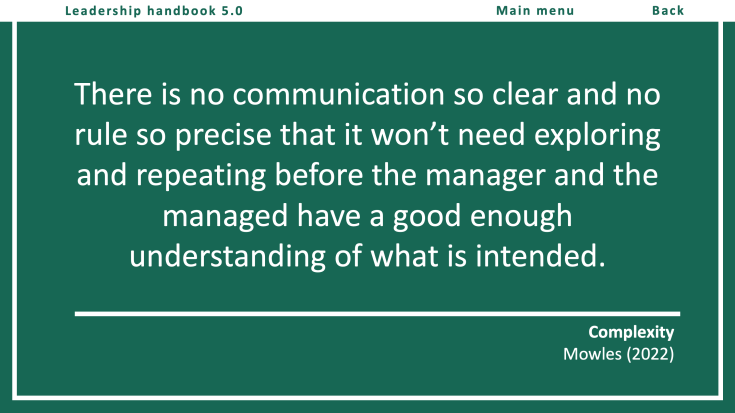
When leaders give a message, we have often spent time thinking it through, probably discussed it with others and chosen our language carefully to give the message. When we give a message though, whether it is about upcoming calendar events, the reasons for doing a particular thing or advice on teaching, we can easily fall foul of the expert knowledge gap. We have spent time thinking about it and give the message in a way that makes sense to us but for others receiving the message, who have not done all that thinking and discussion, the message might not be clear at all. Worse, if we give the message by email or in person without giving the opportunity for those receiving to ask questions, to challenge or to respond, we can easily make the assumption that others hold a similar understanding to us. But Mowles reminds us of the reality:
#2 | The actions that we have asked for have been carried out
Leaders inevitably ask actions of the team. It is easy to pile these on to of one another: mark books like this, build in retrieval practice, adapt tasks for different needs, build relationships with parents, record concerns in this way, write this for the newsletter, input data, moderate in the team, read this article that I found, throw in extra spelling practice, read with every child every fortnight. The list can be endless. We’d be fools to think that all the actions we ask of our team are complete, let alone complete to a standard that we might want. If the things that we have asked our team to do fall away, there is probably a good reason for that. Maybe that do not make a difference to outcomes for children. Maybe they add to workload. Maybe they jar with colleagues’ values. All of which should be taken seriously by leaders, as long as we know!
#3 | Not everything that is planned is taught and not everything that is taught is learned
Teach two hours of PE a week. Remember to fit in French. An hour of English and maths per day. Find time for DT. Don’t forget RE. The timetable is packed and inevitably something has to give in a normal week let alone when there are disruptions from over running assemblies, trips, or the laptops are not working. Ofsted’s intent, implementation and impact framework for inspecting the quality of education comes from work bye Bauersfield in the 1970s:
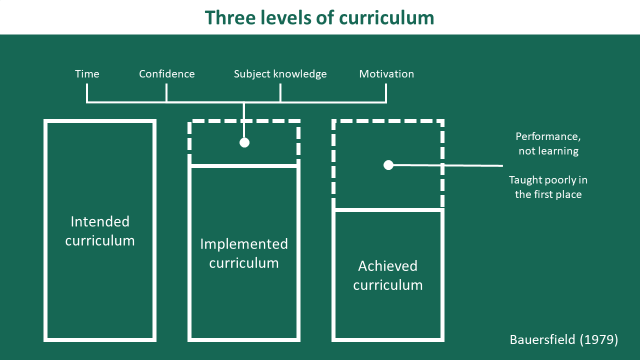
Not everything that is planned is taught is a fundamental trap to avoid when it comes to the imagined school. As is the idea that not everything that is taught is learned.
#4 | The data that we have collected is accurate
Let’s say that teachers assess writing and input that data into a spreadsheet or a tracking system. Even with the most robust of criteria and moderation, there will be disagreements on some assessments. When you throw into that the real or perceived need for a proportion of children to to be at EXS or GDS, it is unlikely that the data stored in the spreadsheet is an exact representation of the learning that children have achieved, particularly when we cannot assess the entirety of the curriculum, only a sample of it. When the data says that 55% of children are exceeding age related expectations, is that really the case? The tyranny of metrics is a useful lense in which to challenge the imagined school.
#5 | The team is fully behind our initiatives
Even with the most careful, collaborative of implementation it is unlikely that all the team feel the same way about any changes or improvements that we bring in. Even if these initiatives have demonstrable impact on outcomes for children, they could come with additional workload, or they may take some colleagues’ attention and time away from others things that they find valuable or important. We might inquire into buy in, even having conversations about the merits of the initiative where colleagues speak positively about it. But what if they are saying what they want us to hear? This would of course indicate a possible cultural problem where a colleague might not want to speak their mind but again we would be foolish to think that everyone is behind everything that we do.
#6 | Our advocated teaching strategies are supported and implemented
Let’s say we have a way of teaching in our school. We might use Talk for Writing to teach English. We might teach whole class reading. We might use I do, we do, you as a structure for modelling. We might use lollipop sticks to randomly select children to answer questions. We might cold call. We might have talk partners. Does everyone use them all the time? Probably not. This is the wrong question though. Should everyone use them all the time? Do we even need a teaching and learning policy? Just because we have run some training, showed everyone that we care about a particular strategy and seen it in action in observation, doesn’t mean that the strategy is embedded. What if it is only wheeled out when a leader is watching?
#7 | The beliefs that we advocate are shared
We might have school values that we promote and talk about. We might pride ourselves on inclusion, or that every child is capable of learning given the right support and adequate time. We’d like to think that these values are ubiquitous across the team but they probably aren’t. Surely there is at least someone who believes that a child with additional needs requires a TA instead of an adapted classroom environment or adapted teaching or scaffold work. Surely there is at least someone who’d rather pluck a worksheet from a teachers resource website as it is than adapt a task that better clings with our curriculum objectives.
Living in the real world, not our imagined world
It is tempting to build an imaginary school where all of our initiatives are implemented fully with everyone on board, where everyone diligently takes on the actions that we ask and children learn brilliantly as a result. What a school we’d have! As Evans indicates, if we make decisions based on this school instead of the real school, we could get it spectacularly wrong, choosing the wrong problem to tackle and choosing the wrong solution too. At best we might get a sigh and an eye roll about how leaders don’t get it and at worst we could actively drive our team away.
Avoiding the traps
The most obvious way to get our imagined school closer to the the real school is to spend more time in it. Leaders can easily find themselves office based but the more time spent in corridors, on playgrounds and of course in classrooms, we give ourselves a better chance of seeing the school for what it is. This also involves interacting with a wider range of people, seeking their views and experiences. Leaders can easily find themselves interacting with a small sample of the workforce and this can give a skewed perception of what our colleagues as a whole think and how they behave. But this must all come with an acknowledgement that we are unlikely to see for ourselves the full reality of our school. I’d argue that there are other ways in which we can avoid the trap of the imagined school that go beyond these.
Check colleagues’ understanding
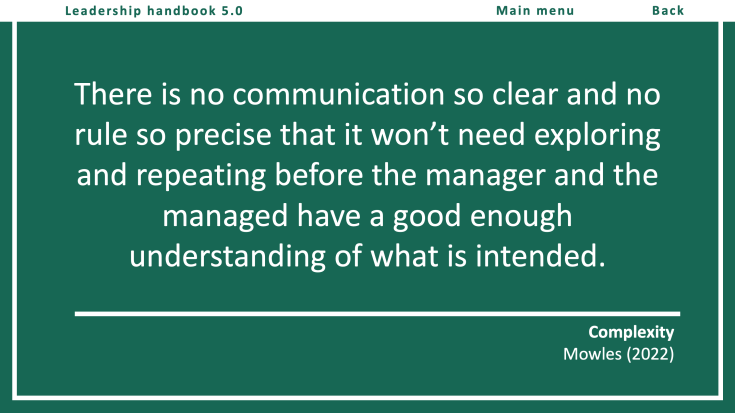
Leaders need to convey all sorts of information and we often spend a fair amount of time thinking this through before communicating. The risk is that it is clearer in our mind than it might be in the minds of those receiving. If a message is worth giving, it is worth checking that it has been understood. One example here is feedback, for example after a lesson. There can be quite a chasm if we’re not careful between what the message we intended and the message received and so it is worth checking: ‘I’ve explained a couple of opinions there about what worked well and what you might do to improve and I want to make sure that I was clear. Could you explain a bit about what you heard from me and what it made you think?’ I find this much more appropriate than questions like: ‘Does that make sense?’
Develop a shared understanding of the 3 levels of curriculum
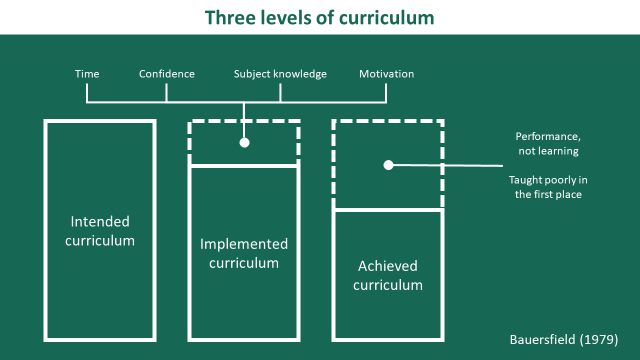
These bars will never be completely equal but our goal is surely to strive for all that we intend to be actually taught and all that is taught to be actually learned. Which units of work or objectives never make it to the children? What are the reasons for that and what do we do about it? What have children actually learned and what has been misunderstood or forgotten? What do we do about it? All these questions, their discussion with others and the resultant actions we take can help is avoid the imagined curriculum trap.
Assume the data is inaccurate
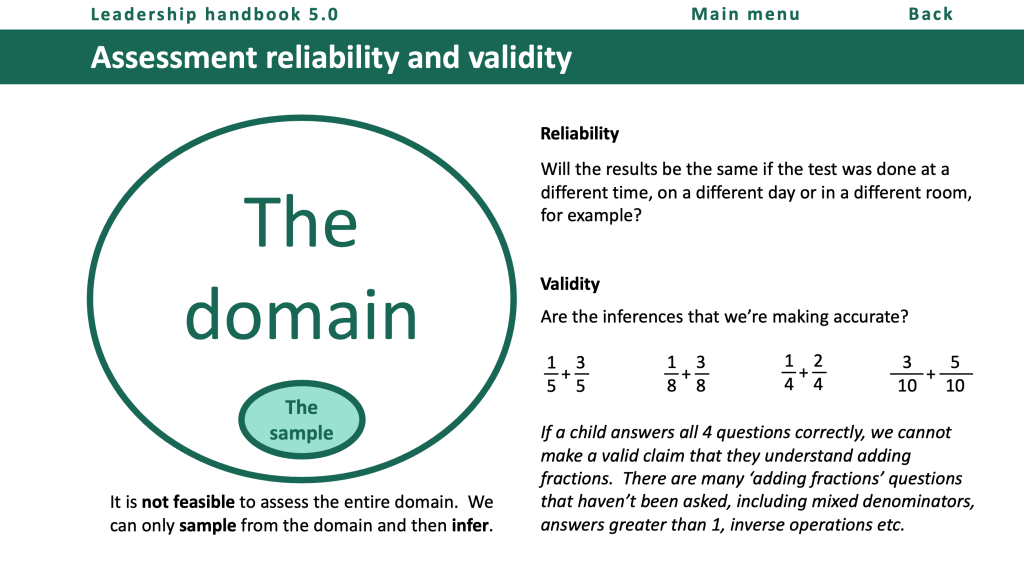
All the data that we collect will have reliability issues of some sort, as well as our inferences having validity issues of some sort. When we’re analysing a set of data, we cannot accept it as absolute truth; we are all at risk of falling for the illusion of certainty from data that oversimplifies complex reality and averages out nuance and context into a more digestible format. So let’s assume our data is inaccurate when we’re making plans to act on the data that we have. For example what about the children who score 32 on the phonics screening check or 95 in a stanardised assessment or just scrape EXS in a teacher assessment. The children with these borderline assessment scores have not ‘made it’ and when they are grouped in with a whole cohort, we might end up with a rose tinted view of group attainment or progress. When we’re analysing data, let’s run our proposed actions through the filter of ‘What if the data is incorrect?’.
Sharpen the why
A real clarity of purpose and priorities can focus our collective thinking and keep us all on the same page. Combine this with a shared language and we might experience fewer misunderstandings and misconceptions.
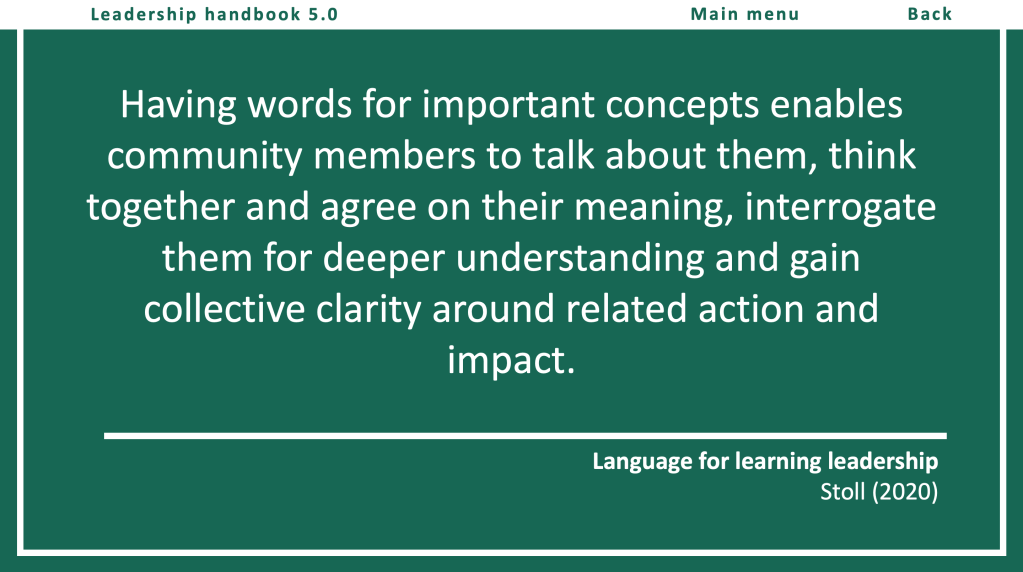
This goes way beyond values and tag lines, with purpose thought of and communicated as a strategy hierarchy from the more abstract at the top into the more concrete, particularly to do with the way that we teach, our identity, further down.
Invite and act on challenge
If we’re surrounded by people that for one reason or another tell us what they think we want to hear, we’ll certainly have quite a gap between the school we imagine and the real school. What is it that makes people feel able to or want to challenge? I’d say there are three things. The first is all the behaviours that contribute to trusting relationships. We have codified ours as:
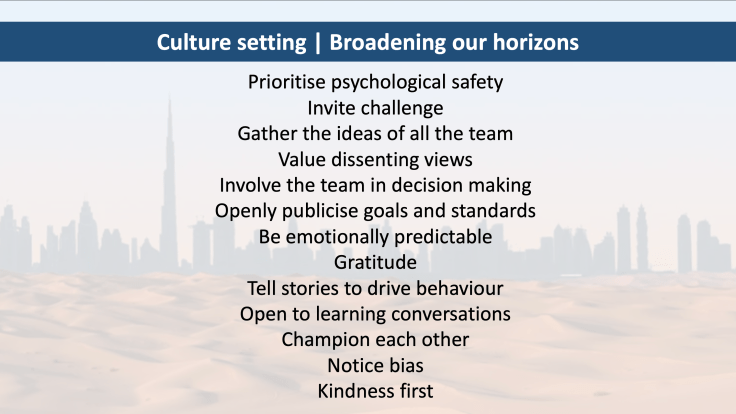
The second (incorporated into this list) is explicitly asking for challenge. Sure, some might offer it without prompting but we have to seek it out from a range of sources. Surveys can be good but nothing beats a conversation. I like the stop, start and continue framework for seeking feedback, particularly the first two for a given area of school life, for example when it comes to assessment and data collection, what should we start doing? What should we stop doing? We need to create structures and points in time to prompt and collect these opinions. And the third thing is that we act on what we’re told. This doesn’t necessarily mean that we do everything that is brought up because inevitable, there’ll be competing opinions that contradict each other from different people. But we can involve the challengers in decision making and come to a decision that acknowledges the challenges received. All of this can give us a much clearer picture of reality and close the gap between this reality and our imagined school.
Do less, better
Initiative overload is a huge contributor to an imagined school that is far from reality. When we have multiple school improvement priorities and multiple incidental priorities that are communicated by what we react and pay attention to, it is inevitable that some of these spinning plates will fall; if everything is a priority, nothing is. There are times of the year when it might be more fruitful to focus on certain broad priorities and therefore tailor things like CPD and monitoring to suit the rhythm of the year.
Summary
The imagined school traps:
#1 | The messages that we have given have been understood
#2 | The actions that we have asked for have been carried out
#3 | Not everything that has been planned is taught and not everything that has been taught has been learned
#4 | The data that we have collected is accurate
#5 | The team is fully behind our initiatives
#6 | Our advocated teaching strategies are supported and implemented
#7 | The beliefs that we advocate are shared
Ways to avoid these traps:
Spend more time in different parts of the school and interact with a wider range of people
Accept that truth doesn’t rise to the top
Check understanding
Develop a shared understanding of the 3 levels of curriculum
Assume the data is inaccurate
Sharpen the why
Invite and act on challenge
Do less, better