
School improvement model
What is it and how do we formulate one?

How do you go about improving your school?
This post provides an example school improvement model and seeks to pull out some generalisations that could inform sector wide work, as well as providing advice for school leaders on formulating their own school improvement model.
Assumptions
It is useful to consider the parameters that we are working within in when we conceive of a school improvement model. For me, they are:
Schools are complex. The are multiple agents interacting and influencing each other in ways that vary in how predictable they are, how desirable they are and how proximal the effects are seen.
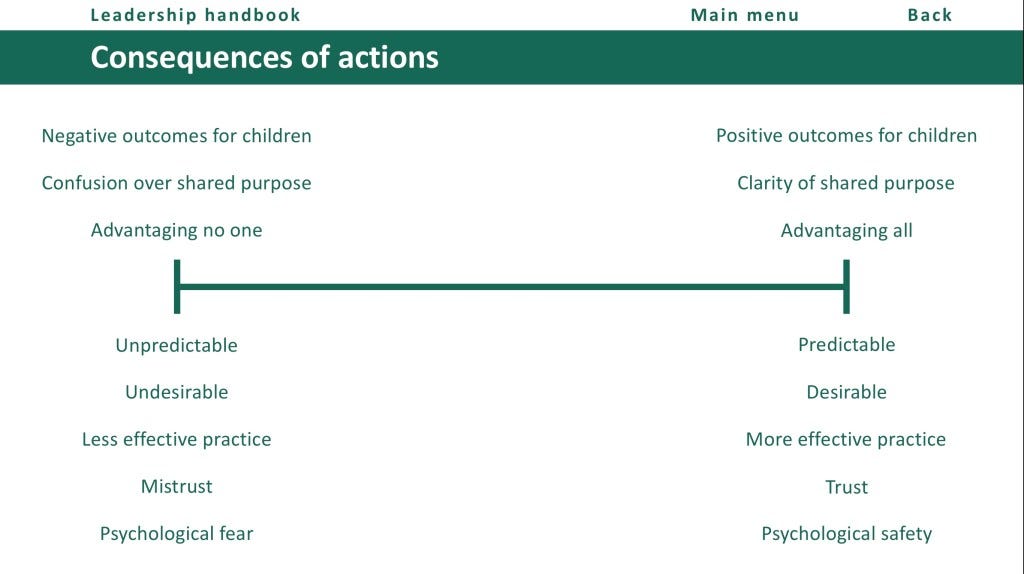
School leadership is problem solving, not applying a formula. Despite essentially doing the same work, each school has a unique context; Dylan Wilam tells us that nothing works everywhere and everything works somewhere.
Problem solving requires expertise. While it is common rot try and define the behaviours of effective leaders, how they behave and the decisions that they make is determined by what they know.
Schools need to be good at building knowledge. Adapting to complex environments such as schools requires the curation, ease of access and sharing of knowledge. There can be no improvement in outcomes for children without individual adults, teams and the organisation as a whole learning more, learning better and learning faster.
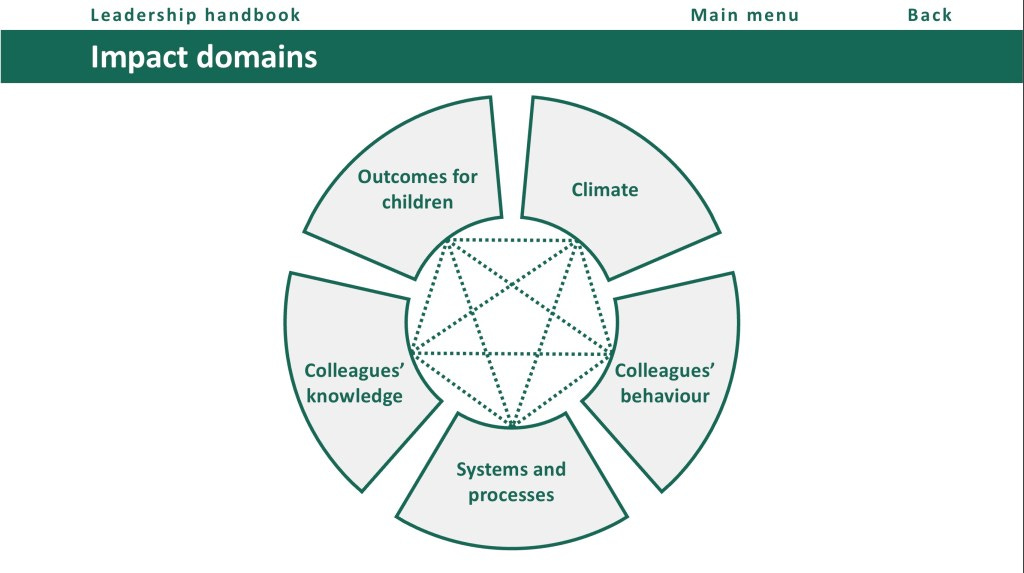
Leaders can improve their schools in different domains. Outcomes for children are the ultimate desired impact but they are the most distal too. There are other domains which leaders can influence that contribute to those outcomes.
Why is this important? School improvement is not a lone endeavour and leaders’ collective beliefs determine the actions that they take and the consequences of those actions.
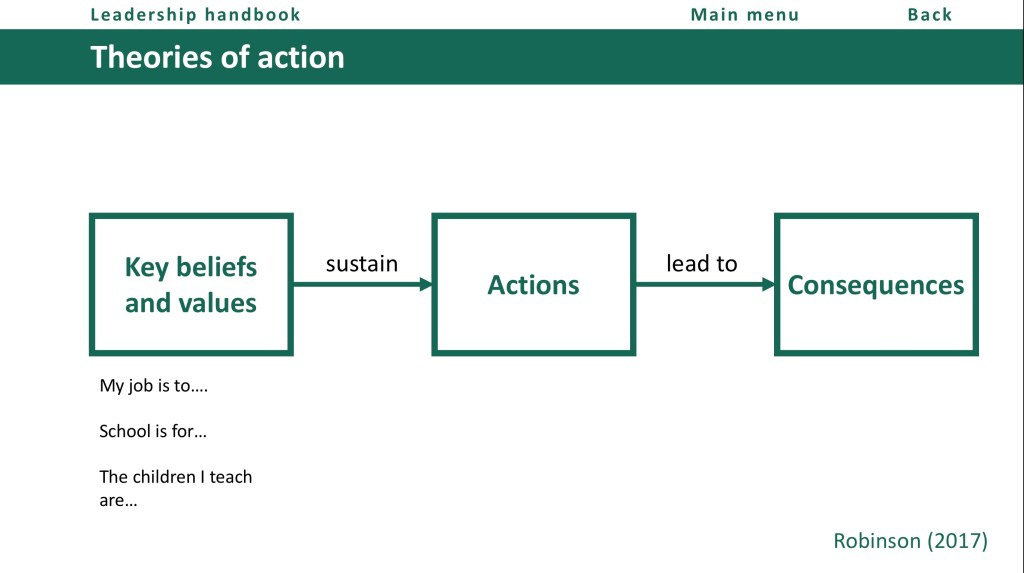
A school improvement model is based on assumptions of the nature of school leadership.
Clarify these first, individually and with other leaders.
Learning at the heart
Schools improve when children develop academically, socially, emotionally and much much more. At the heart of an improvement model is therefore maximising the chances that children will learn what we intend and make the most of opportunities for incidental learning in all sorts of domains too. An improvement model has to have some focus on the individual teacher and what is expected of them.
There are many, many examples of schools mandating or advocating teaching strategies. The problem with some of these is how applicable they are to different age ranges, different subjects. different levels of prior knowledge within a class and different school contexts. Standardisation of teaching strategies across a key stage, a school or a group of schools might serve the purpose of raising a low baseline of quality of teaching to an acceptable level, but longer term, more sophisticated improvements require a more nuanced approach.
As such, a model of improvement that supports teachers to understand and solve the problems that they experience, selecting from a range of possible strategies seems a better bet.
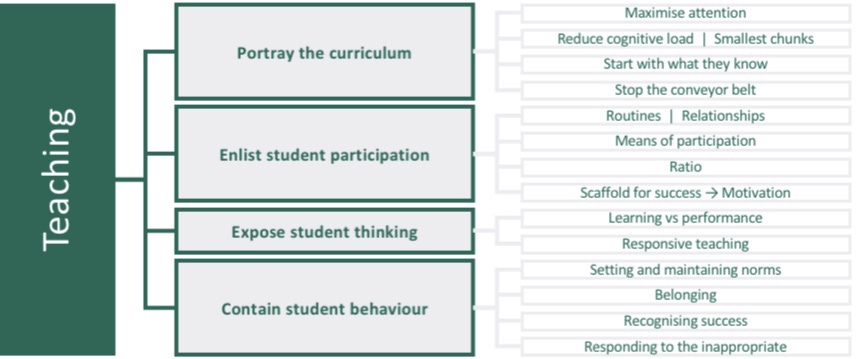
Being able to solve these problems requires expertise in different domains, shown in the above image connected to each common problem. Maximising attention and reducing cognitive load increases the likelihood that children can form meaning. By focusing on means of participation and ratio with a good understanding of learning vs performance, scaffolding and responsive teaching, teachers can build the knowledge needed to solve the persistent challenges of teaching.
A school improvement model focuses on the mechanisms of how children learn and what individual teachers can do to influence this.
Work on a shared understanding of this to enable teachers’ decision making.
Influencing learning at scale
School leaders, charged with supporting multiple teachers and improving multiple classrooms are also solving problems, albeit different ones. How do we support all teachers to get better at solving their problems?
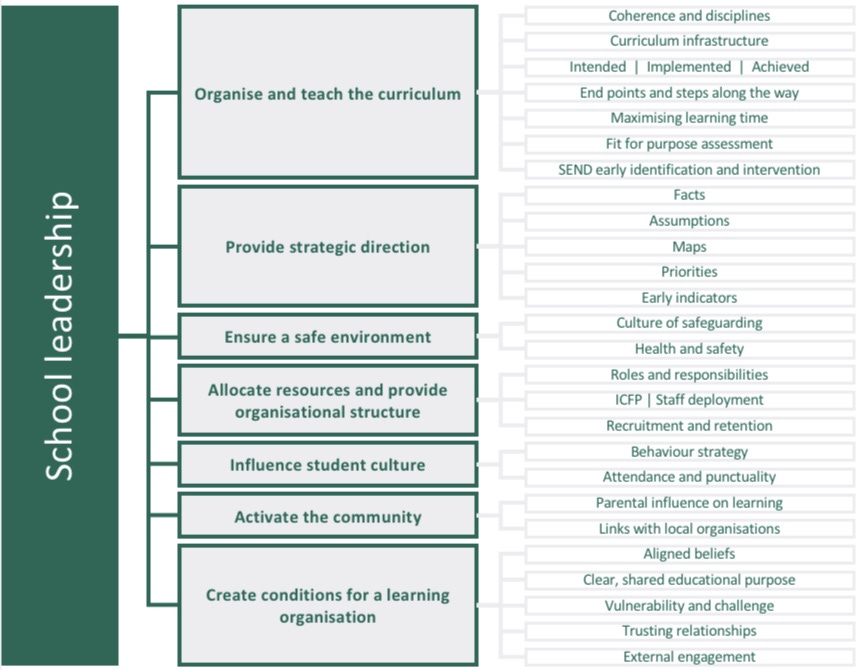
In order to tackle these problems, leaders need expertise in curriculum and assessment, in evaluation and strategic planning, in behaviour strategy, in defining values and purpose, and in creating conditions of trust. But arguably above all, leaders need expertise in professional development in all it’s possible forms. There can be no school improvement without individuals, teams and the organisation developing their expertise and skills.
But the typical model of twilight CPD and INSET days is too often disjointed. Leaders having expertise in these areas is necessary but not sufficient to influence the practice of multiple teachers. Colleagues may well be learning more informally through their day to day work than through the more formal systems that we try to establish.
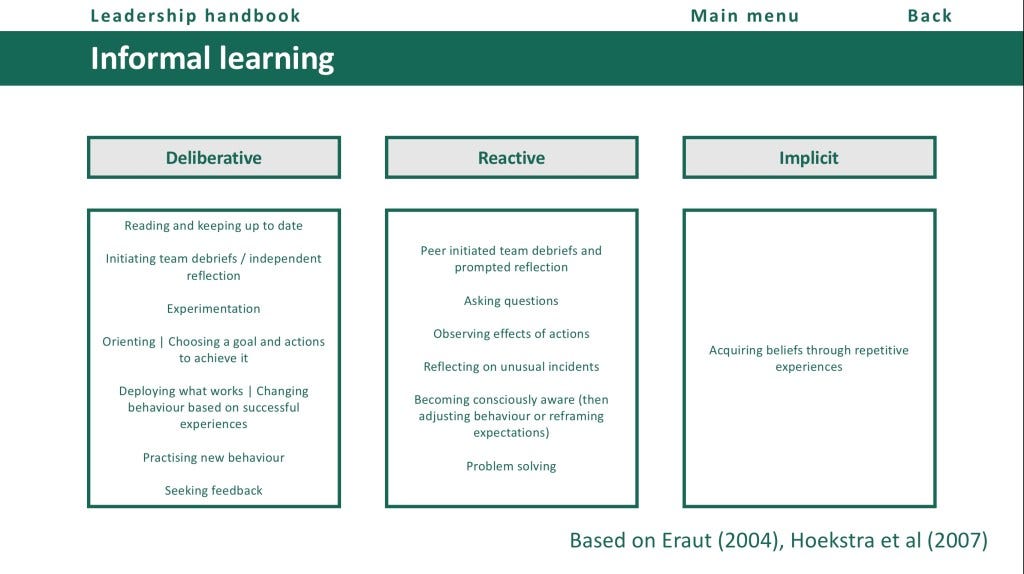
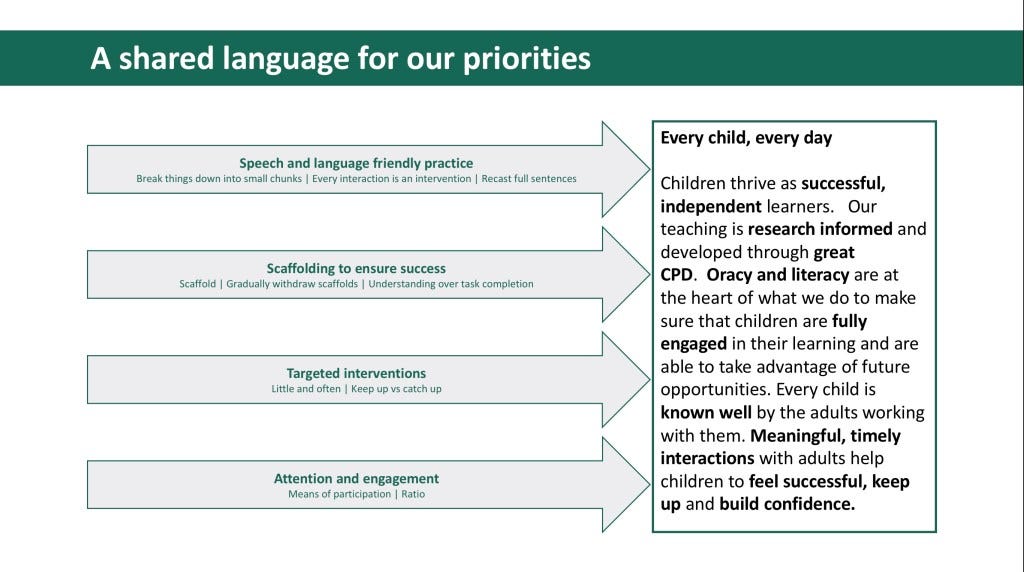
To make the most of these informal opportunities, it becomes vital that there is a shared language for talking about problems, priorities and strategies so a school improvement model must plan for how the team talks, not only because it allows more meaningful collaboration but because changing how we talk changes how we think and if we are to help colleagues to get better, we have to target their beliefs.
What might this look like? Well most schools will have a vision of some sort that defines the future; what we want the school to look like. Then they’ll probably have implementation plans that set out who will do what, when, how much it will cost and how it will be monitored. Such boxiness in action planning fails to take complexity into account because schoo life is never this easily defined. An alternative? Lots of talk about what we’re aiming for, the strategies that we’ve chosen and the specific language that we’ll use to to develop shared understanding.
A school improvement model defines the expertise that leaders need to solve the problems of school leadership.
A school improvement model considers mechanisms for individual, team and organisational learning.
A school improvement model identifies the language used for developing shared understanding.
A model for multi school leadership
System or executive leadership as the next layer above school leadership involves the solving of different problems once more, with yet more domains of expertise required in collaboration, complexity, standardisation, and a people strategy.
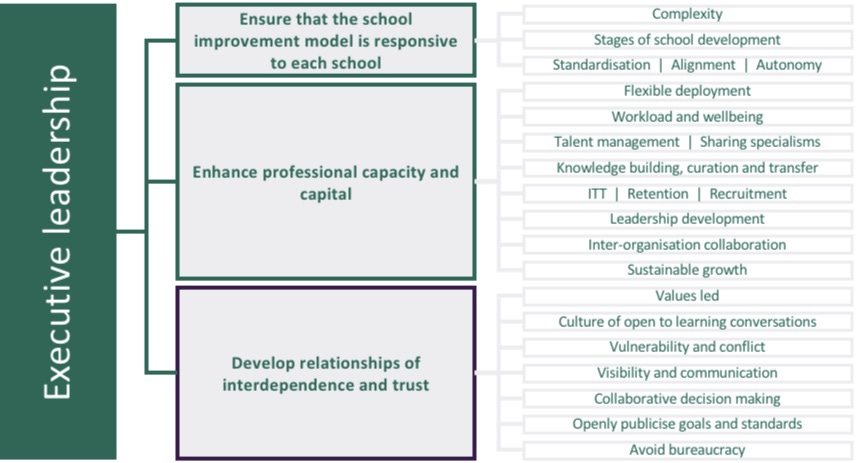
Context is everything. What one school in a federation or Trust needs will be completely different to another, even in the same location, because of the unique combination of circumstances:
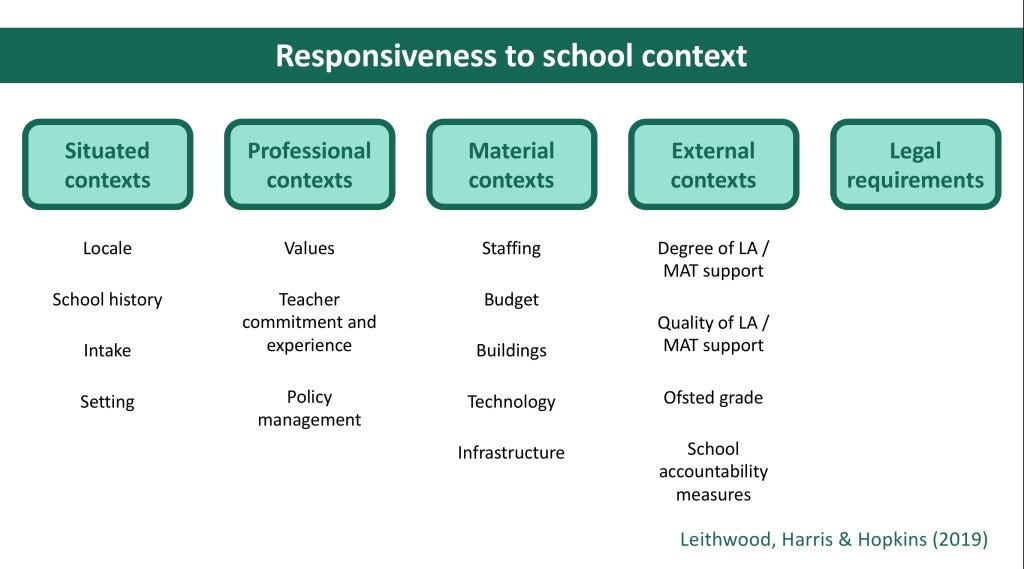
However there is also the consideration that individual schools change over time, and that an improvement model may evolves as a school improves (or declines):
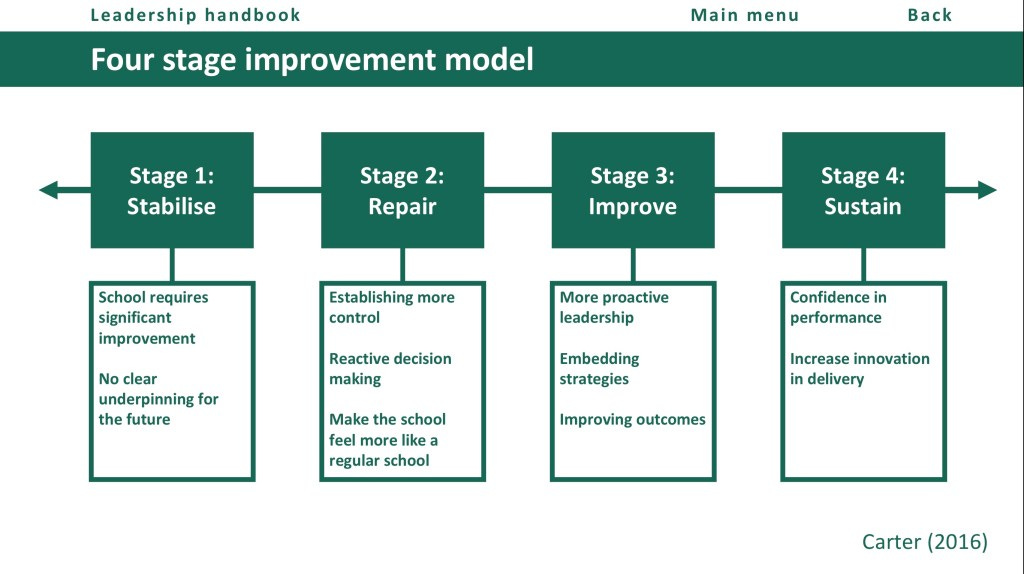
A school improvement model is specific enough to address a school’s needs yet general enough to be adapted for different circumstances.
Forming a model of school improvement | Some generalisations
This is my draft of a model for school improvement:
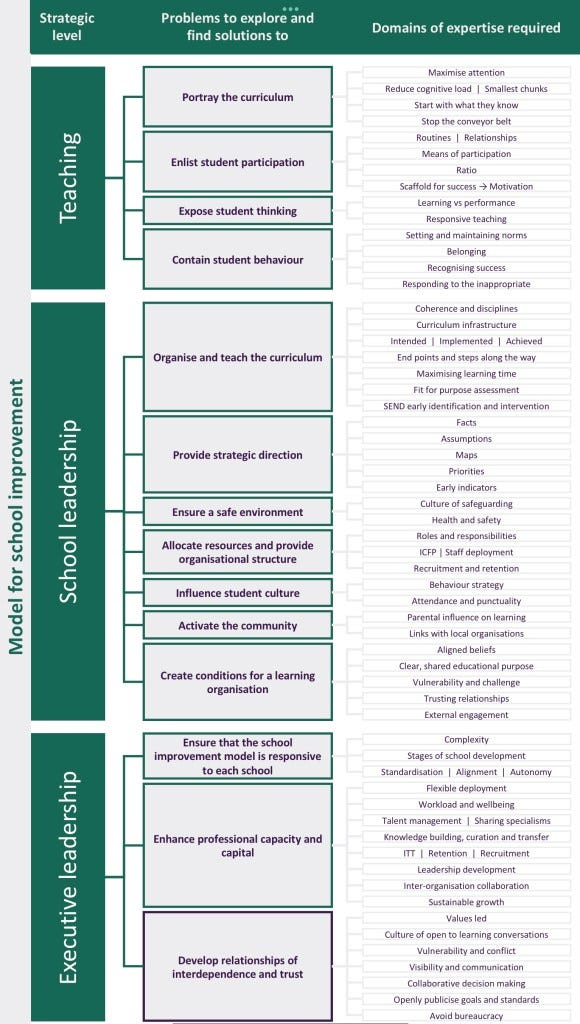
I’m not advocating that this is entirely transferable to other schools; I think that the value is in leaders formulating their model for their contexts. However, it may be of use to pull out some principles that can help guide school and executive leaders in clarifying a model that works for them:
A school improvement model is based on assumptions of the nature of school leadership.
A school improvement model focuses on the mechanisms of how children learn and what individual teachers can do to influence this.
A school improvement model defines the expertise that leaders need to solve the problems of school leadership.
A school improvement model considers mechanisms for individual, team and organisational learning.
A school improvement model identifies the language used for developing shared understanding.
Leaders might then choose to:
Clarify their and their teams’ beliefs and assumptions about school leadership.
Work on a shared understanding of how children learn to enable teachers’ decision making.
Figure out what they would like colleagues to be expert in.
Design systems for individual, team and organisational learning, including the shared language required for collaboration.
Review all of this regularly and make adaptations depending on context.
Middle leaders are key drivers in improving teaching, setting culture, etc. To do any of this they require instruction in evidence based PD. The EEF guidance discussing mechanisms is a fantastic starting point.