
Predictably unpredictable

Finding discomfort in the school improvement process is a rite of passage for school leaders.
We can argue that schools are complex, adaptive systems which goes hand in hand with rejecting the notion that most of what we do is merely complicated. And complexity 101 points us towards the idea that outcomes are difficult to predict, that change is uneven, that context matters. And yet, in the same conversations, we speak with certainty and confidence about how the system will behave. We anticipate resistance. We expect initiatives to plateau. We recognise the signs of compliance without commitment. So which is it? If schools are complex, how can we claim to predict them? And if we can’t predict them, what exactly are we doing when we plan for improvement? We can hold two conflicting ideas at once but maybe we’re acting on the wrong one.
There’s the nuance: complex systems are unpredictable in their outcomes but we could argue (with caution) that there are predictable emergent patterns of behaviour. We cannot say with confidence what will happen but we can become better at recognising the patterns through which systems respond. Over time, these patterns become familiar. Push harder and something pushes back. Introduce something new and it shows early promise before settling into the existing culture. Address one issue and another emerges in its place. The details change but the dynamics don’t.
A reasonable response
Most school improvement plans are entirely reasonable. They set out goals. They define success criteria. They identify actions. They allocate responsibility. They create a structure through which progress can be monitored and reported. They attempt to bring clarity, coherence and accountability to complex work. And yet they don’t always lead to the improvements we expect. Some of the most significant improvements are not captured in these documents while the intended improvements that are documented might not happen at all.
The problem is predictable: we design plans based on how we hope the system behaves, not how it actually behaves. Plans tend to assume a world in which cause and effect are relatively direct. Do this and you will get that. Improve teaching and outcomes will rise. Introduce a new approach and practice will shift accordingly. This is reasonable; it is how we are required to present improvement, particularly in the context of governance and regulation. Plans need to be legible. They need to show intent, structure and accountability. They need to make sense to those who are not inside the day to day complexity of the school.
We have to treat school improvement as complicated
Despite all this, we are required to present improvement as if it is linear. Plans must show a clear line from action to impact. Evidence must demonstrate that what we did made a difference. Accountability systems depend on this logic. Without it, governance becomes difficult and external assurance becomes almost impossible. So we compress complexity into a format that can be understood and evaluated. Goals. Actions. Success criteria. Impact. But it becomes a problem when we begin to believe it. While the plan may present a neat story of improvement, the system it is applied to is far less tidy. We are not wrong to do this. In many ways, we have no choice.
The illusion of control
Plans create a sense of control. They allow us to say: this is what we are doing, this is why we are doing it, and this is how we will know if it has worked. They give coherence to something that would otherwise feel uncertain. They help us explain our actions to others and, perhaps more importantly, to ourselves. But that sense of control can be misleading.
It’s easy to construct the narrative of improvement after the fact. We look at what happened, identify what we did and connect the two. Sometimes that connection is valid. Often, it is more ambiguous than we would like to admit. Other factors were at play. Other interactions mattered. Other interpretations shaped what people actually did. The plan helps us explain improvement but it does not necessarily cause it.
The system pushes back
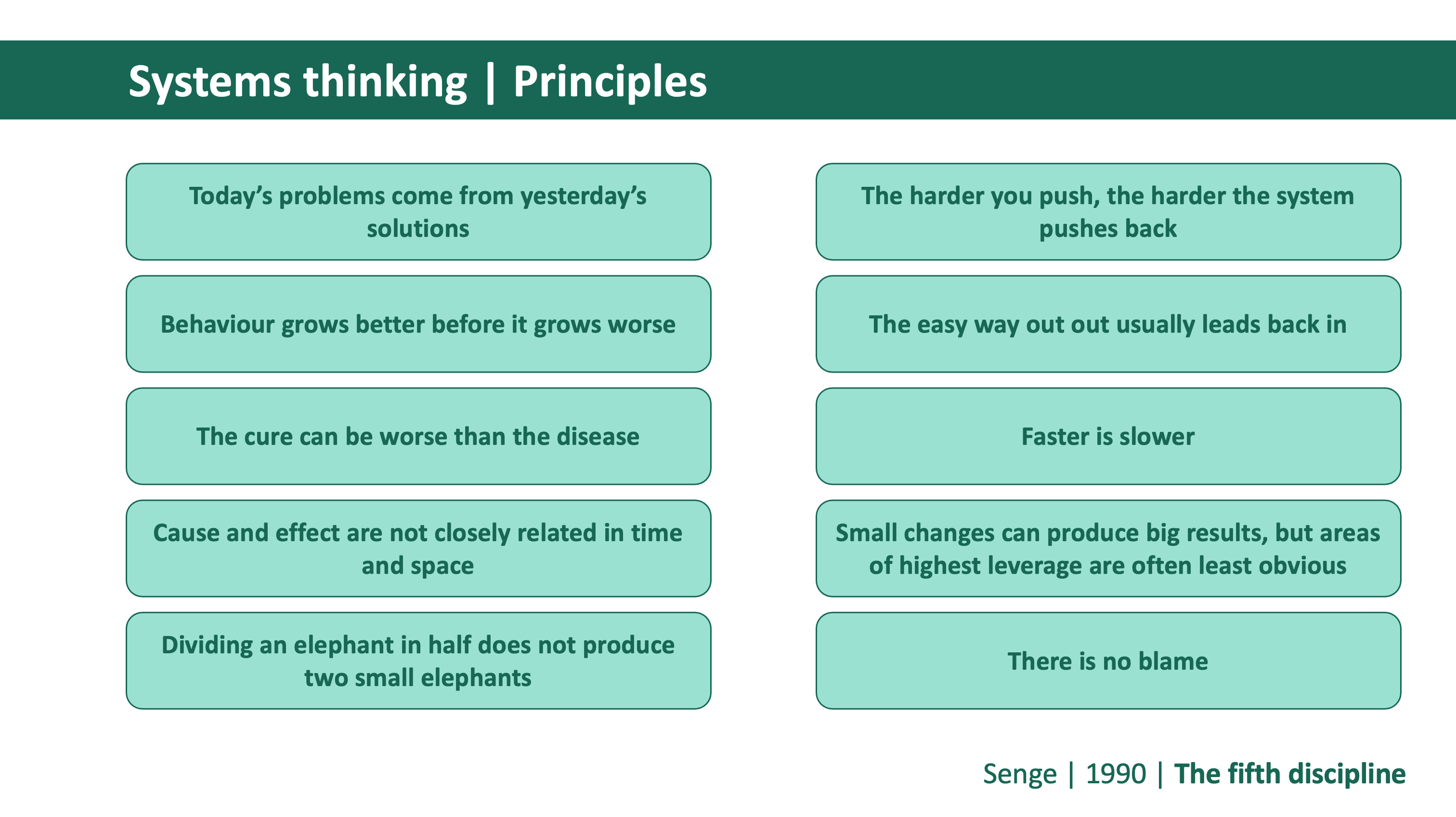
Systems thinking principles help to make sense of this. One is that cause and effect are not closely related in time and space. Actions taken now may have consequences that only become visible later and those consequences are shaped by everything that happens in between. This makes it difficult to know, in real time, whether what we are doing is working.
Another is that the harder you push, the harder the system pushes back. Increased pressure often produces behaviours that appear to align with expectations but do not necessarily reflect deeper change. Compliance rises and risk taking falls. The system stabilises itself in response to the pressure being applied.
A third is that the easy way out usually leads back in. We address the most visible problem, often through a quick or familiar solution, only for the underlying issue to reappear in a slightly different form.
These are recurring patterns. They show up across different schools, different contexts and different initiatives. They are part of how complex systems behave.
Variation and the limits of fidelity
Another implication of complexity is variation. The same action will not have the same effect everywhere. Different subjects, different year groups, different teachers, different cohorts all shape how our improvement efforts are interpreted and enacted. Context matters.
This is where the idea of fidelity becomes more troublesome. We often assume that doing something as intended will lead to the intended outcome. But what does as intended mean in a system where interpretation is inevitable? Where each teacher, each team, each leader makes sense of an initiative through their own experience and context and based on local interactions with those in their team? Ashby’s law of requisite variety offers a useful provocation here: only variety can absorb variety. If the system we are trying to influence is complex and varied, then our response must be capable of matching that complexity. A single, tightly defined approach is unlikely to be sufficient on its own.
When fidelity to an approach hasn’t happened, people in the system might not be resisting improvement for the sake of it. They are making rational decisions based on the pressures and information available to them. If accountability increases, they respond in ways that help them manage that pressure. If time is limited, they prioritise what feels most immediate. If expectations are unclear or shifting, they interpret them in ways that make sense locally. What looks like resistance can be adaptation.
And adaptation is exactly what complex systems do.
Plans that are blind to patterns
We are working in systems that have predictable patterns of behaviour but we are designing plans that assume predictable outcomes. We are required to present improvement as linear, even when we know it is not. We create documents that are cleaner than reality and then judge ourselves against them. Our plans are incomplete. They capture intent but not interaction. They define action but not interpretation. And so we see the same patterns repeat, often with increasing effort and diminishing return. When improvement doesn’t happen, we tend to look first at implementation. Was it done properly? Was it followed through? Was it monitored closely enough? These are reasonable questions. But they are not always the right ones.
If complex systems are unpredictable in their outcomes but predictable in their behaviour, then we need better school improvement pattern recognition. We’re already good at the structures and templates for narrating improvement but we need to proverbially sharpen our axe; sharpen our conception of how it is that (our) schools improve and plan for emergence. June’s #LeadershipHandbook post provides the prompts, ideas, tools and templates to support that thinking…