
Planning ahead

I am convinced that most schools can improve by being more organised. Yes, we can and should seek to refine our curriculum, our pedagogical approach and the way that we lead behaviour, but the relatively low hanging fruit is organisation and planning ahead.
Complex problems such as reducing a budget deficit, sustainably increasing enrollment or introducing new curricula can take years. And we also need to consider future problems such as those related to population data, the performance of competitors, the development of new technologies, the maturity of regulation frameworks, the employment landscape and the needs of our community. This kind of thinking ahead is difficult enough on its own, let alone when competing with the day to day problem solving of school leadership so I argue for the planning ahead sweet spot of the annual rhythm of the year that can enable future thinking while providing clarity in the here and now.
The annual rhythm
The school year has distinct phases. Planning ahead involves what the school pays attention to and the work it does at different times of year to tackle its complex problems and consider its future problems.
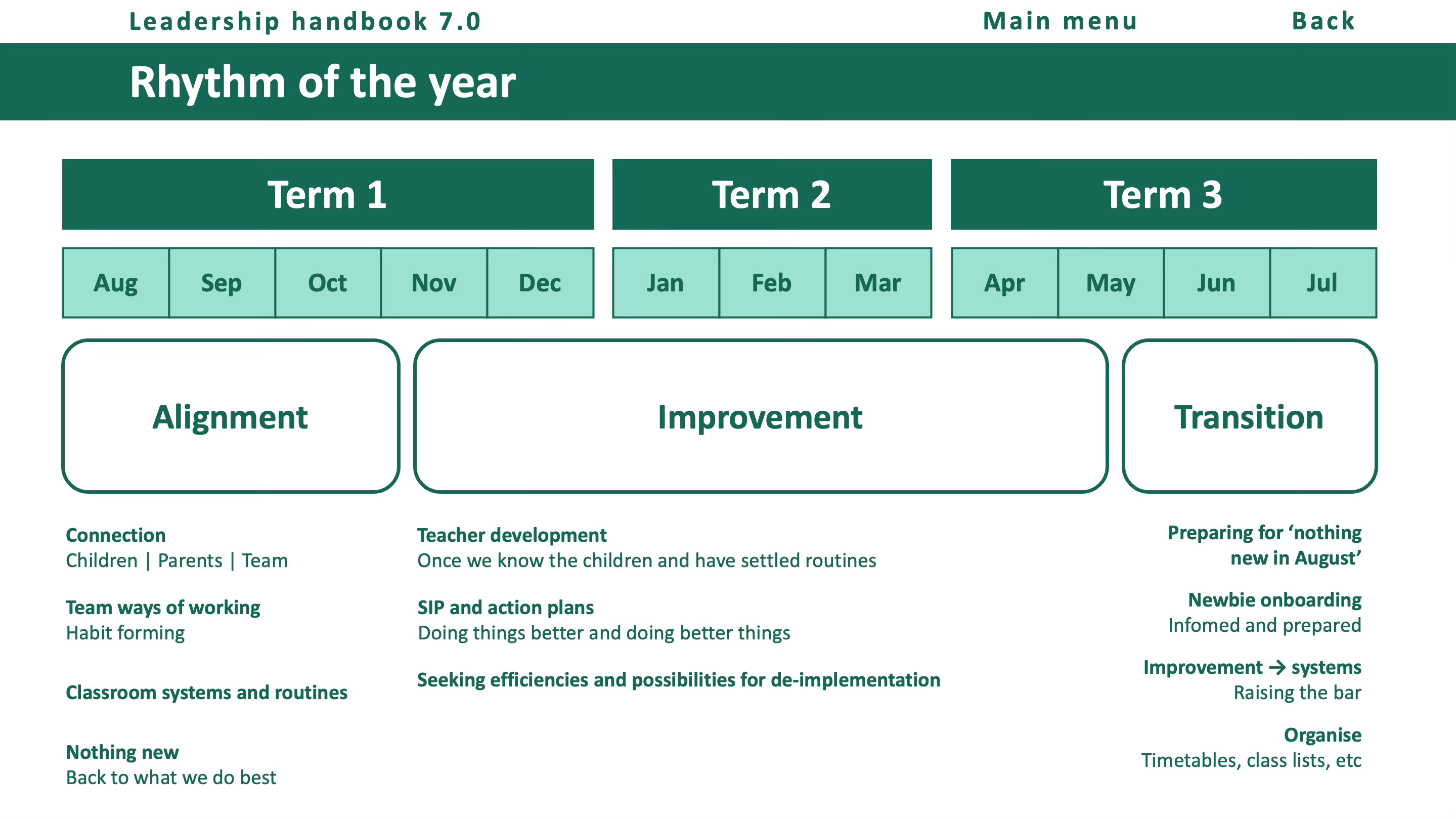
While this kind of planning ahead can provide some clarity and direction, it cannot hold the kind of detail that is required to realise the top level thinking, therefore planning ahead involves providing a structure for leaders to work within and the next time frame to consider is the monthly rhythm.
The monthly rhythm
Schools can easily become overwhelmingly busy at different points of the year if we do not deliberately schedule key events. So where do we start? We might start with planning ahead for accountability requirements. We are held to account by governing boards and regulators with governance activity at set times. Most school will have termly board meetings with set agendas that scrutinise all aspects from school life. They need locking in and then leaders need to plan backwards from there to make sure the right information is available to those responsible for governance to do their job. Most schools will do some stakeholder surveying, as well as some health and safety and safeguarding audits. Don’t let these creep up. Identify when these things happen and publicize them to enable planning ahead by other leaders.
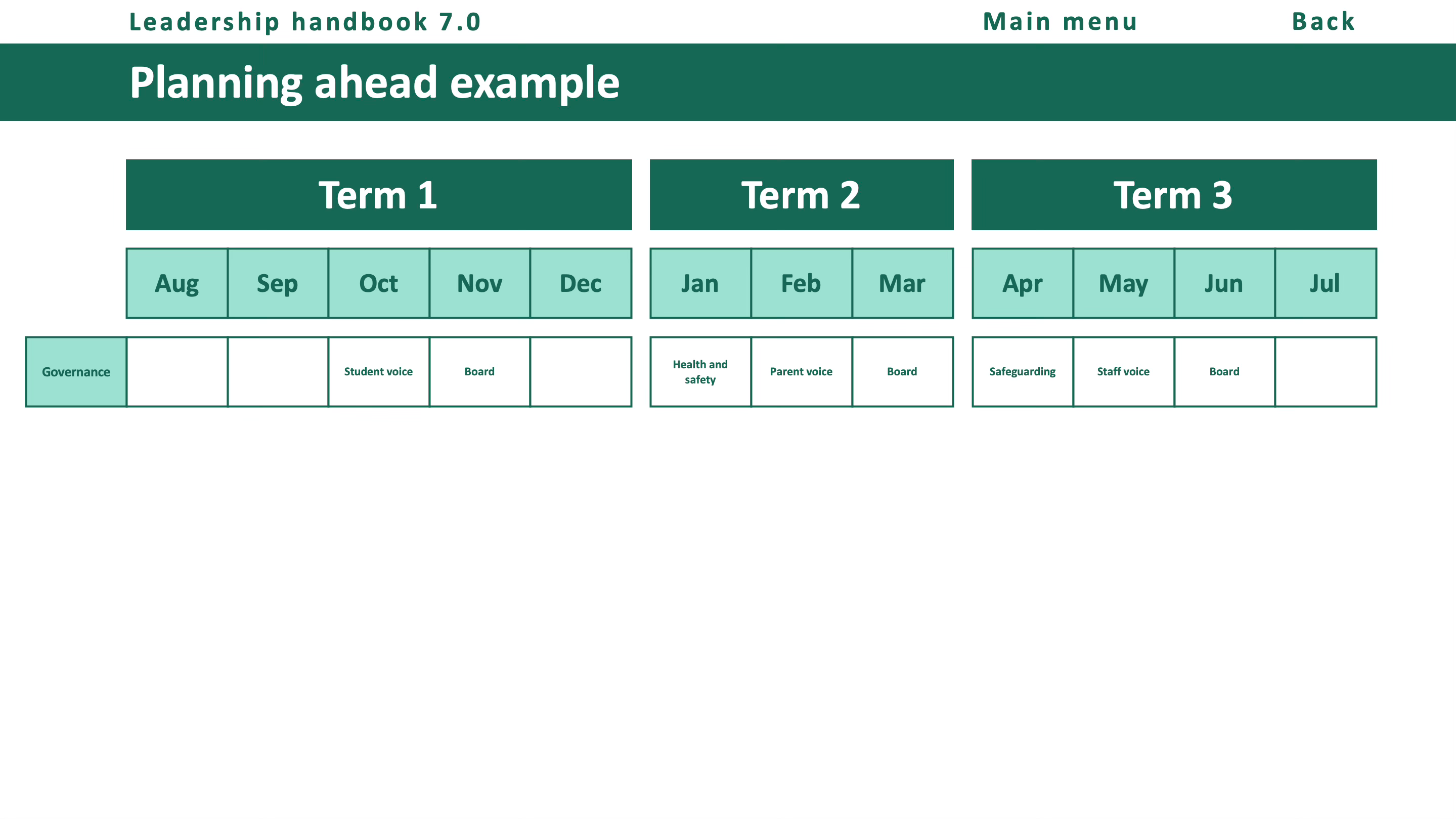
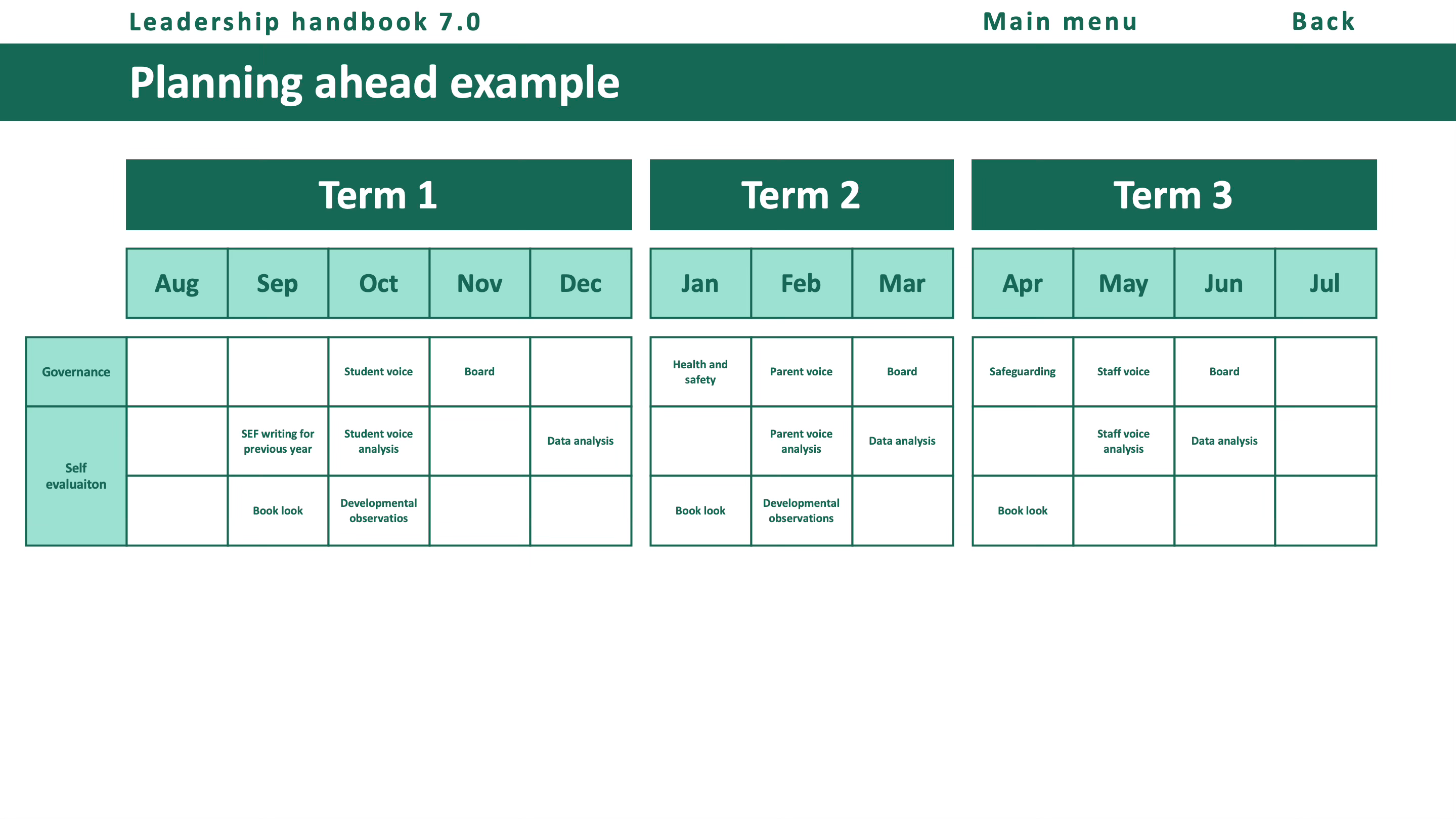
Those responsible for governance need to see leaders’ self evaluation so let’s build that in. Data collection and analysis needs to be locked in for achievement data and for surveys such as student, parent and staff voice. Achievement data is fairly fixed but we have decisions to make about surveys. When shall we do them? Why there? Then there is the qualitative data collection through lesson observations and book looks that most schools will do. When do we do those? Why? And when do we spend time pulling together all these insights into our SEF writing? Why? Is it driven by governance deadlines? Regulator deadlines?
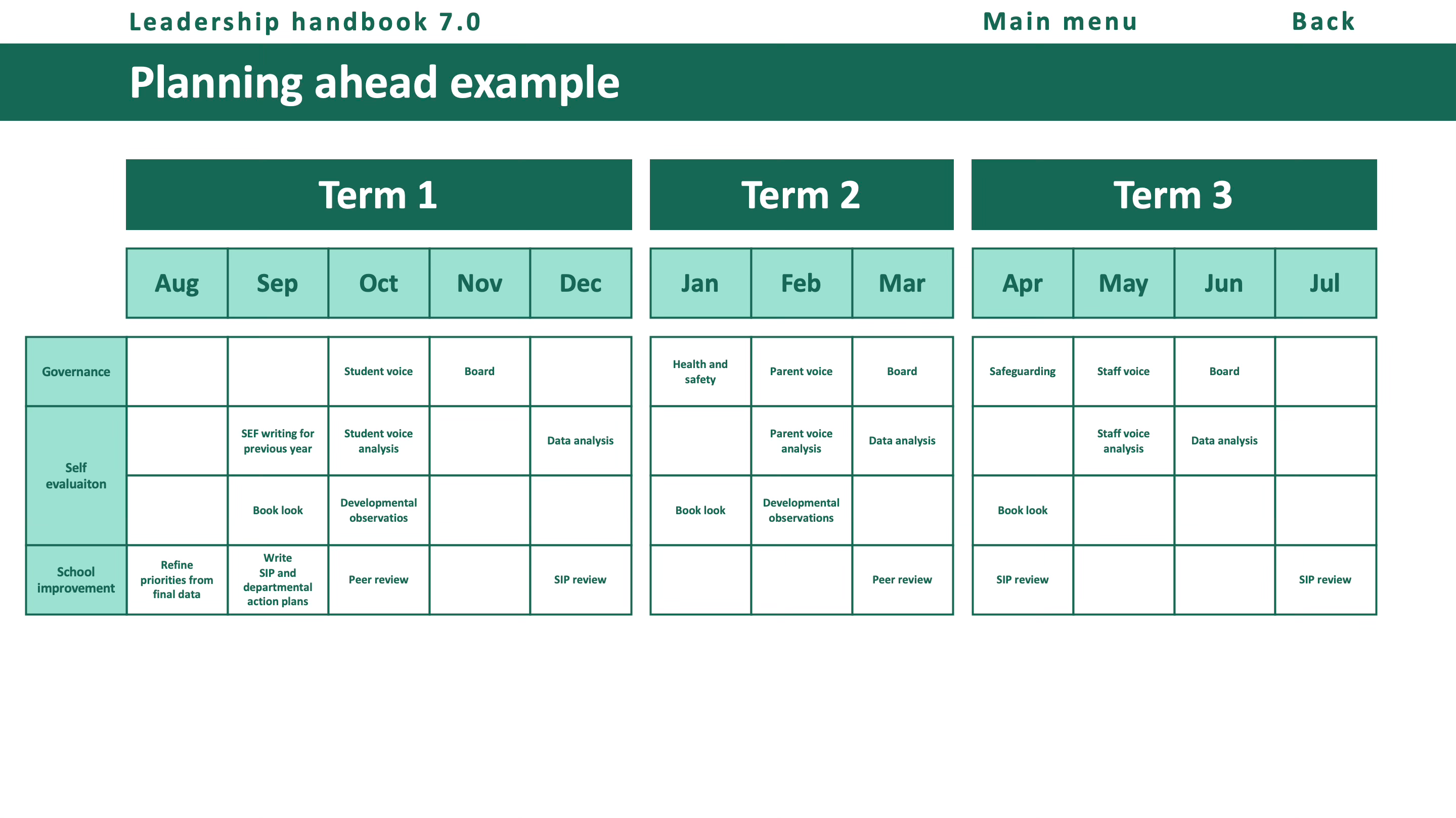
With accurate self evaluation, we can figure out the school improvement cycle. When are priorities finalised? When is the School Improvement Plan written and shared? When do we review it? Let’s build that in.
When we know the priorities that we’re working on, we turn to CPL for the year. How do we go about helping teachers to become better? When do we do that?
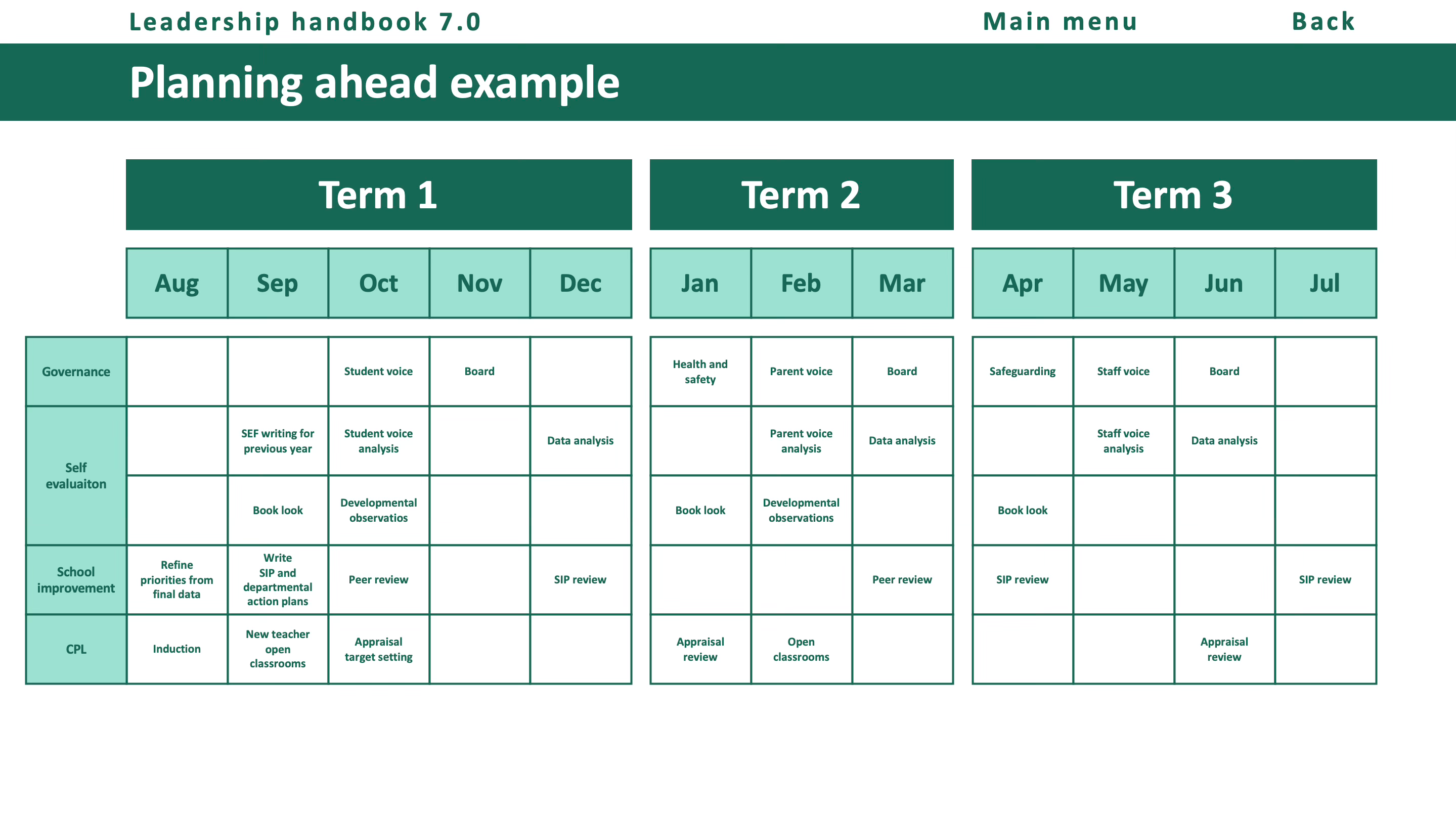
We may have planned ahead for when key activities need to happen across the year but there are other demands on time. Let’s consider the out of hours requirements, the things that take focus away from all the improvement work such as parent teacher meetings, report writing and open days. If we need teachers to be at work for some evenings and weekends let’s map it out well in advance to provide clarity:
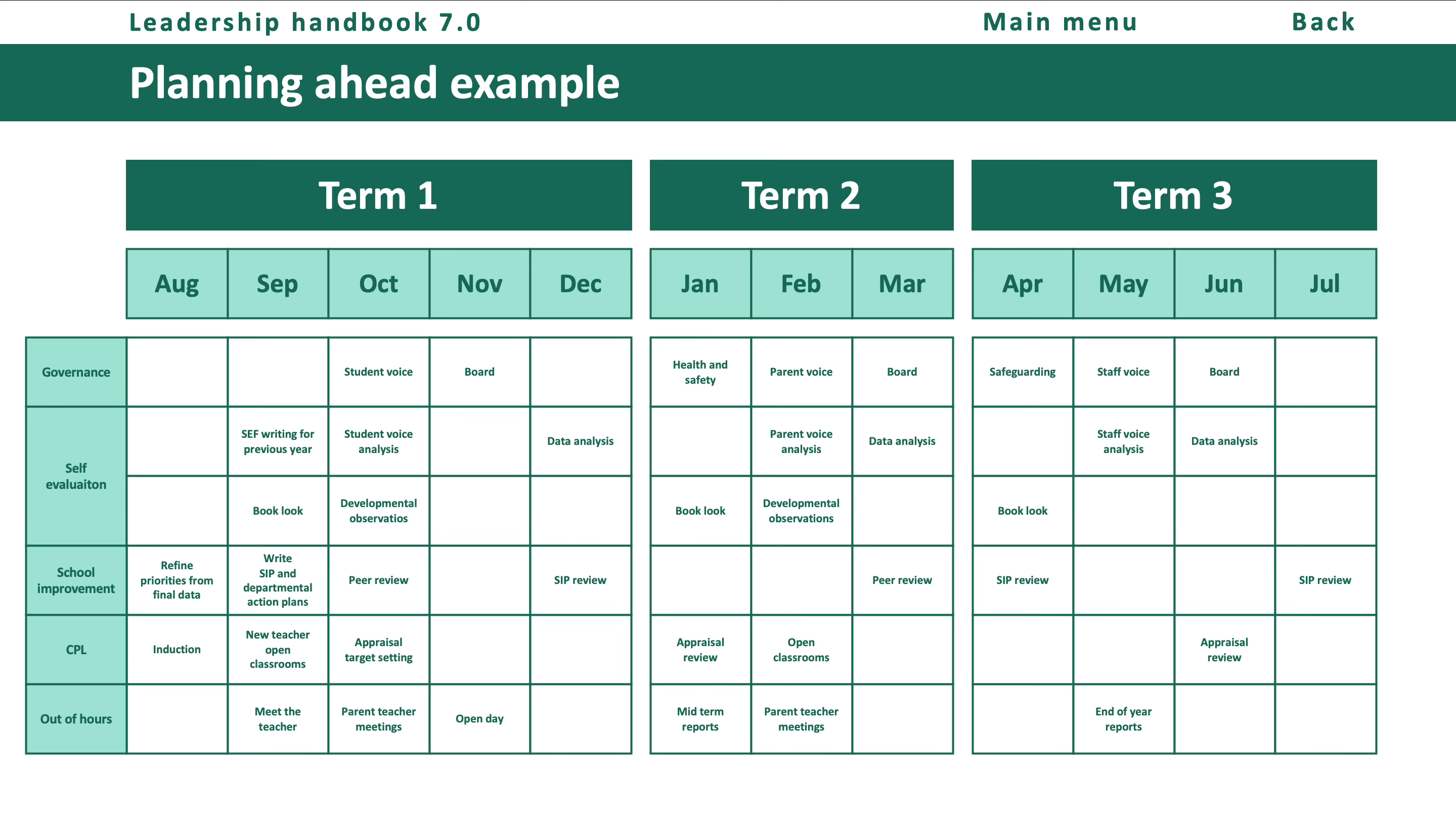
What can move?
Once all of these demands for our attention are mapped, patterns appear. Some months are too heavy while others are curiously empty. This is the moment where we must ask:
Which activities sit in the wrong month? Which cannot move?
Which can be brought forward or pushed back?
Which can be simplified without losing quality?
Where do we need breathing space or to build momentum?
Which rhythms genuinely support improvement, and which survive only because we ‘always do it then’?
There is no perfect calendar, only clarity: What are we doing, when are we doing it, and why at that moment?
How do we use this?
Imagine that every significant cultural and operational artefact is mapped by month, aligned to the phases of the year and spaced in a way that avoids crunch points. How do we use it? The simplest and most powerful move is to make the plan a standing item at SLT meetings: planning ahead.
Example 1 | Assessments coming up
If there is a data collection point in the next few months, we organise:
Timetables
Communication to middle leaders
Administration guidance for teachers
Analysis protocols
Templates for reporting
This avoids the last-minute scramble that eats leadership bandwidth.
Example 2 | Book looks approaching
If a book look is scheduled, we prepare:
The purpose and focus
Sampling criteria
Who’s involved and what cover is needed
How we will feed back to teachers
How we will feed back to SLT
Clear communication to teachers
A quick sense-check with a few trusted colleagues
This protects trust and ensures the process yields insight rather than noise.
Example 3 | Parent teacher meetings coming up
Preparation might include:
Checking the sign up platform
Writing guidance for teachers, students and parents
Protecting time for teachers to prepare
Clarifying the role of non teaching staff during the event
Organising room layouts, refreshments and signage
Supporting new teachers with FAQs and coaching
All of this goes better when it isn’t designed the week before. When a leadership team plans ahead in this way:
Teachers experience fewer surprises
CPL becomes more meaningful
Improvement work gains momentum
The school feels calmer
Leadership attention moves from firefighting to sense making
Time is used deliberately rather than reactively
The most strategic thing a school can do is often the simplest: plan with enough foresight to protect the work that matters.