
LO: Write learning objectives and success criteria

As teachers we put all our effort into striving for children to learn the things that we think are valuable but we sometimes overcomplicate the systems that we use to make this happen. Deciding what we want children to learn and the work that they will do to make that happen is the bread and butter of teaching so it is well worth thinking deeply about.
Does learning even happen in one lesson?
In short, no. Learning happens over time; the result of multiple, iterative interactions with the content within and across units of work. Yet we have learning objectives for individual lessons and and are happy to tell ourselves that children have achieved our learning objective if they complete the work that we set. This is a classic example of conflating learning with performance:
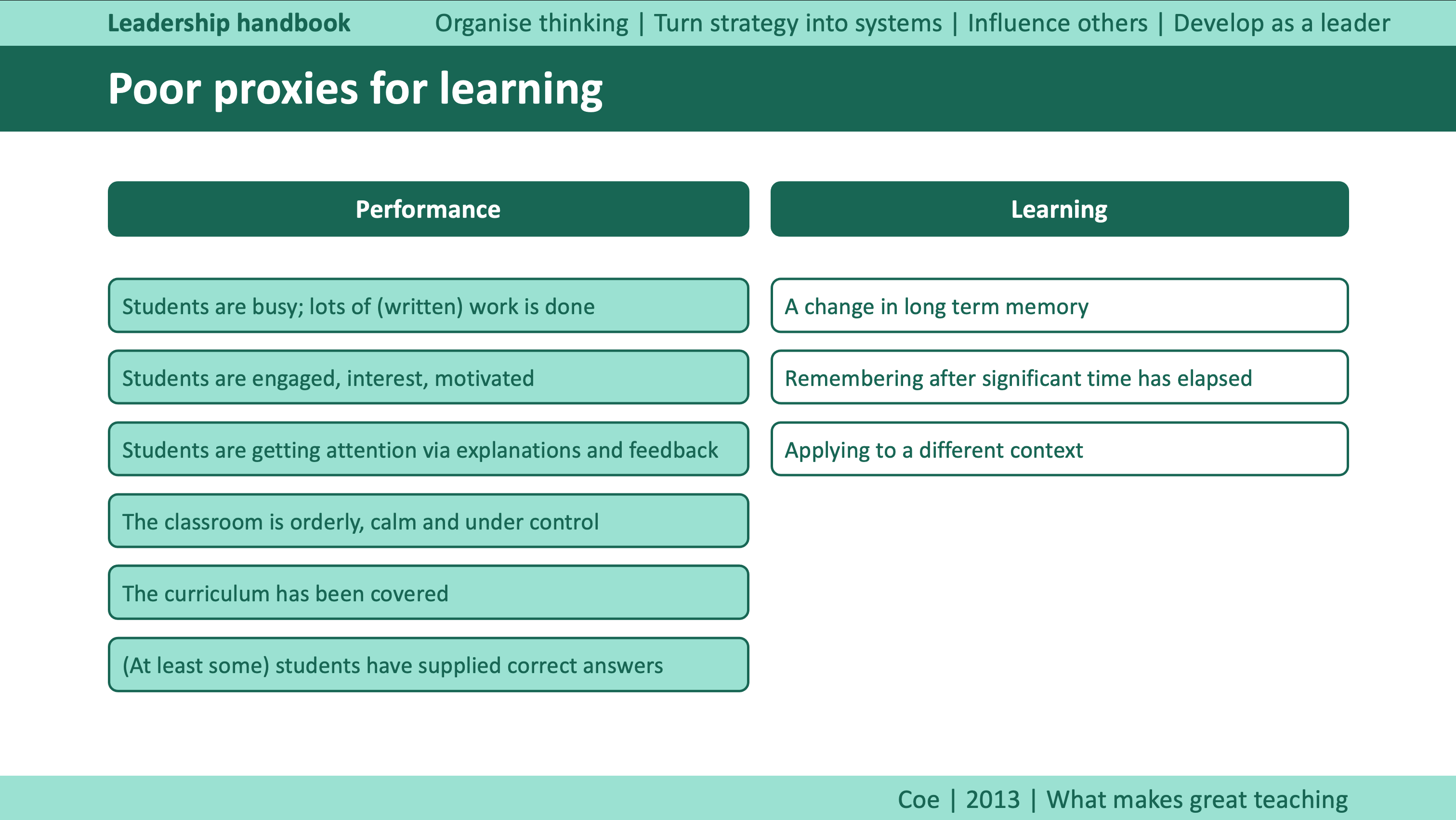
Now of course, those things on the left hand side there are all desirable things. They just might not be actual learning. For learning to happen, children need sustained interaction with a concept and most will need it broken down into the smallest of chunks in order to mitigate the limitation of working memory.
Clarity
I would argue that it is probably more beneficial in most situations to have clarity rather vagueness. After all, teaching is such a complex challenge:
[Teachers] portray curriculum content in a way that renders it comprehensible to naive minds; for students who are not necessarily interested in learning; and whose grasp of the content is not readily visible to the teacher; and who are restless and easily distracted; in a way that satisfies the teachers’ personal needs.
Kennedy (2016) Parsing the practice of teaching
If we are going to be able to portray curriculum content in a way that renders it comprehensible to naive minds, we have to be clear. And this starts with clarity of intention. Whether we call it a learning objective, a learning intention, an enquiry question or something else, what matters is that we have a very clear idea of how learning happens and therefore what we want children to eventually learn. Aiming for clarity helps us to be responsive to children’s needs. With a precise objective and success criteria, we can model more clearly and identify where exactly children might be going wrong:
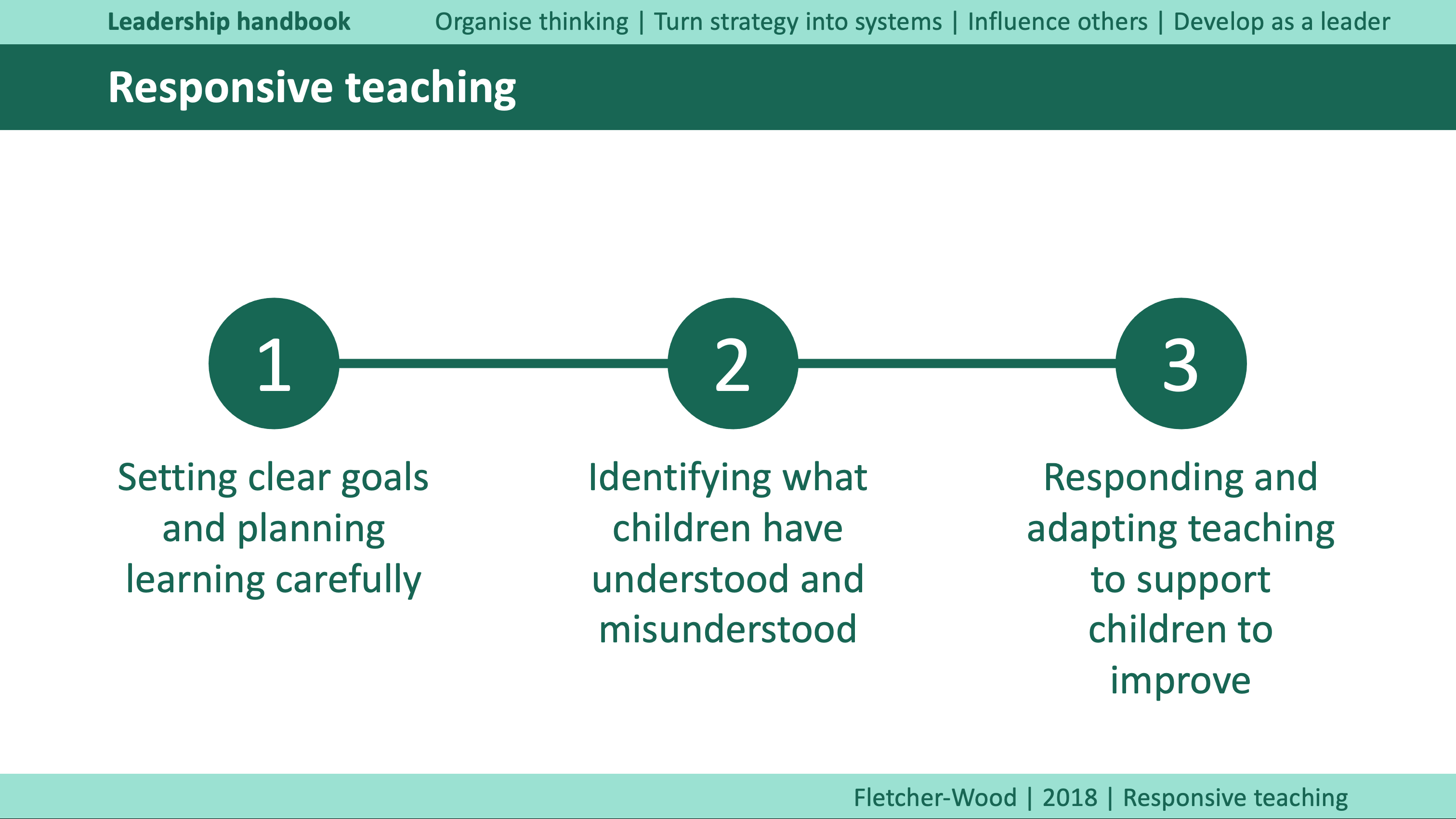
There’s a particular trap to avoid here when it comes to bringing clarity to what children are learning.
Intended learning, not a task description
One of the most common examples of lack of clarity is the mixing up of learning and task. Shirley Clarke makes this point and argues for decontextualising learning objectives:
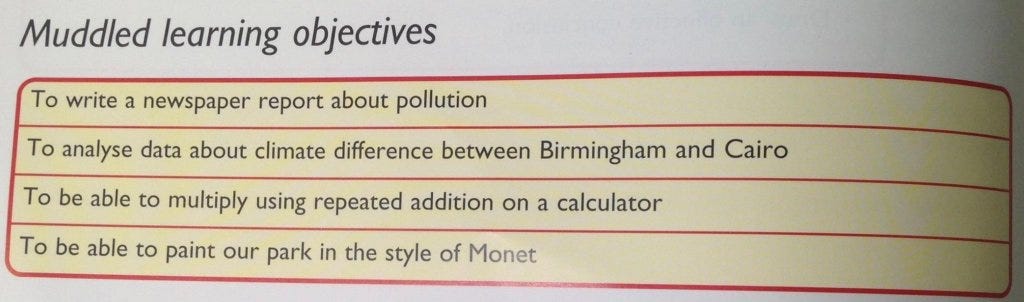
Why is this important? I would say that if a goal of teaching is to increase the likelihood that children can transfer their learning, then having such specific goals probably hinders that somewhat. The first task above has a very specific context but what might we want them to transfer? To wrote a newspaper report about anything? That’s still a task! Maybe we want them to stimulate a reader into action, or inform the reader about an issue. These are the things that are valuable to learn and are arguably more transferable. Peps McCrea explains this well:

Forming a learning objective
Where do we start? Well we might start with the national curriculum. But the national curriculum is not a scheme of work. It simply details what children should be taught by the end of each key stage, sometimes split by year group as a guide. We cannot simply lift statements from the national curriculum and have them as lesson objectives because they are probably not precise enough to bring clarity to about an hour’s worth of time.
So we might start instead with our subject overview or scheme of work, as long as it is not simply a copy and paste job from the national curriculum. A well designed curriculum will have an end point in mind and detail the steps along the way:
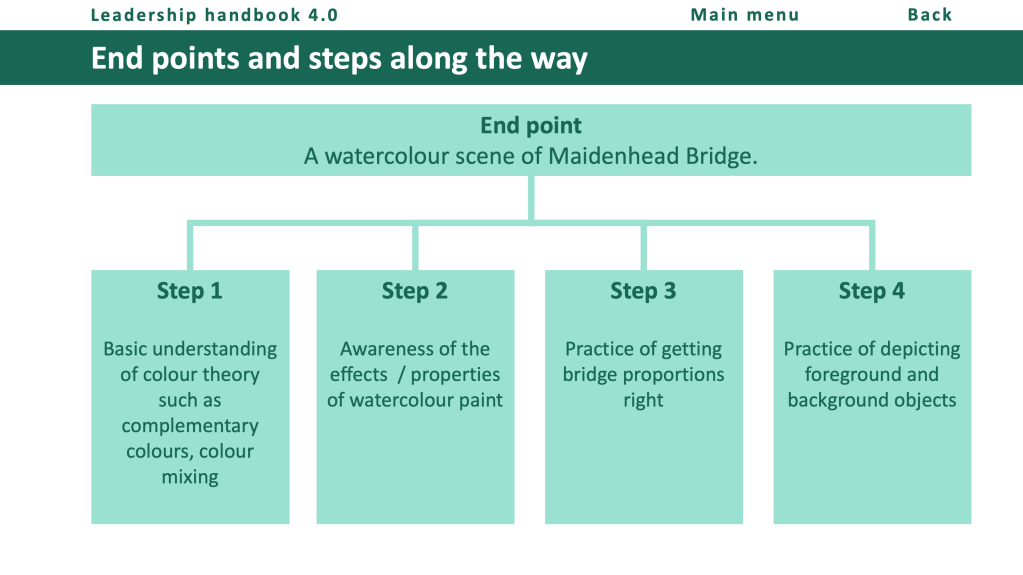
This makes it a lot more straight forward in identifying what exactly we need children to think about or to practise in any one lesson.
Closed vs open learning objectives
Shirley Clarke differentiates between objectives that are closed and objectives that are open:
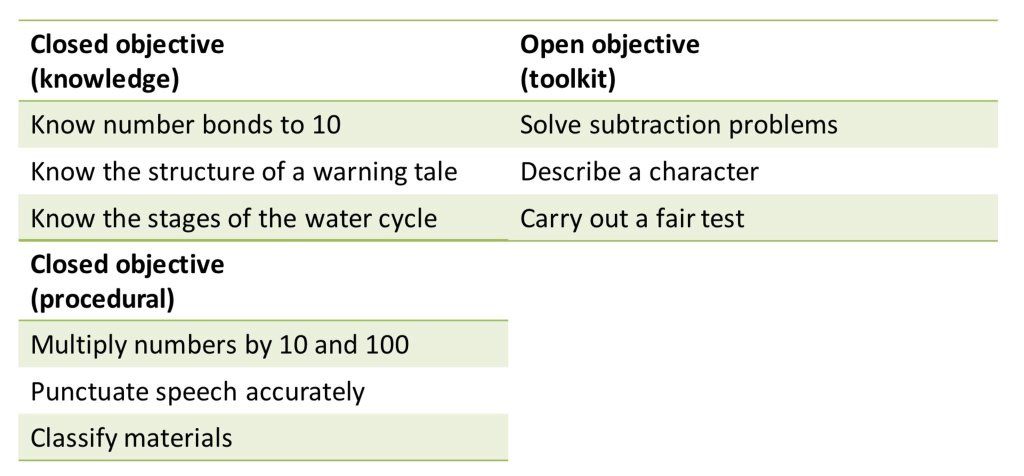
Closed objectives are absolute. Success is binary; children can either know it or they don’t yet. They can either do it or they can’t yet. Open objectives however suggest that success is on a continuum. The way that a child solves a subtraction problem might be anywhere from very efficient to very inefficient. The way that a child describes a character could be very effective or not particularly effective at all. Why is this important? Because it determines the type of success criteria that is most appropriate.
Procedural vs qualitative success criteria
When the objective is closed and success is binary, success criteria is in the form of following instructions. Here are examples for solving ratio problems and working out the area of compound shapes.
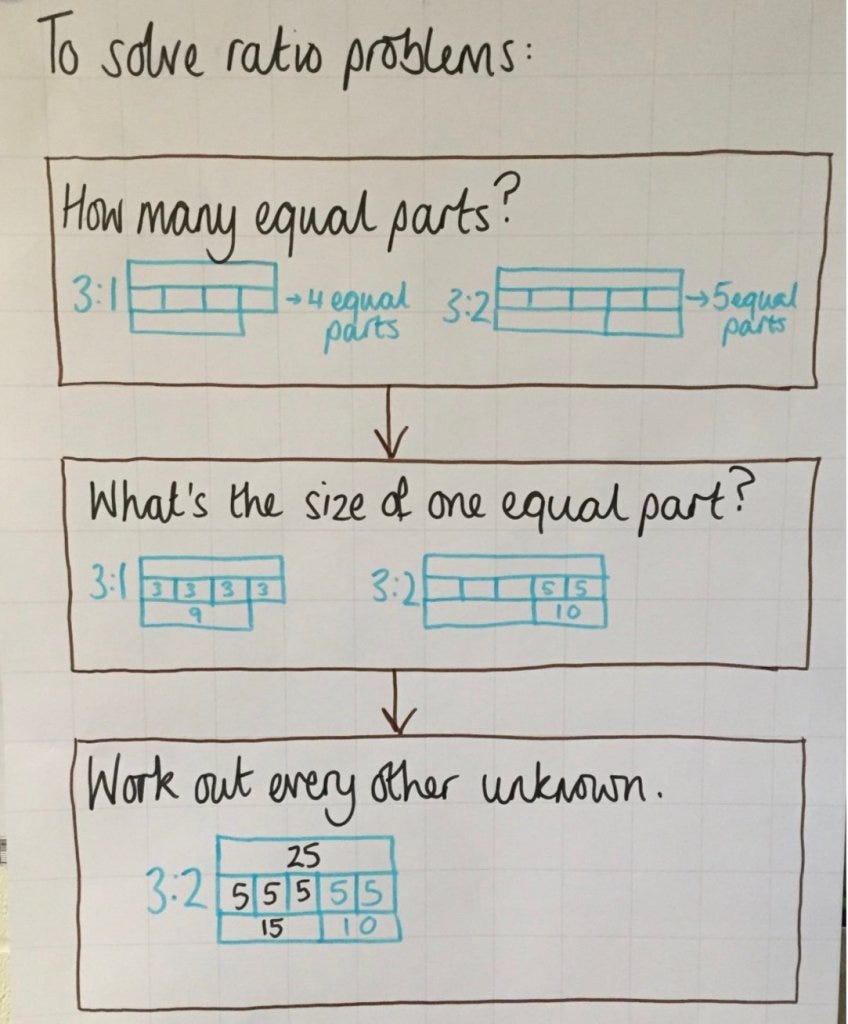
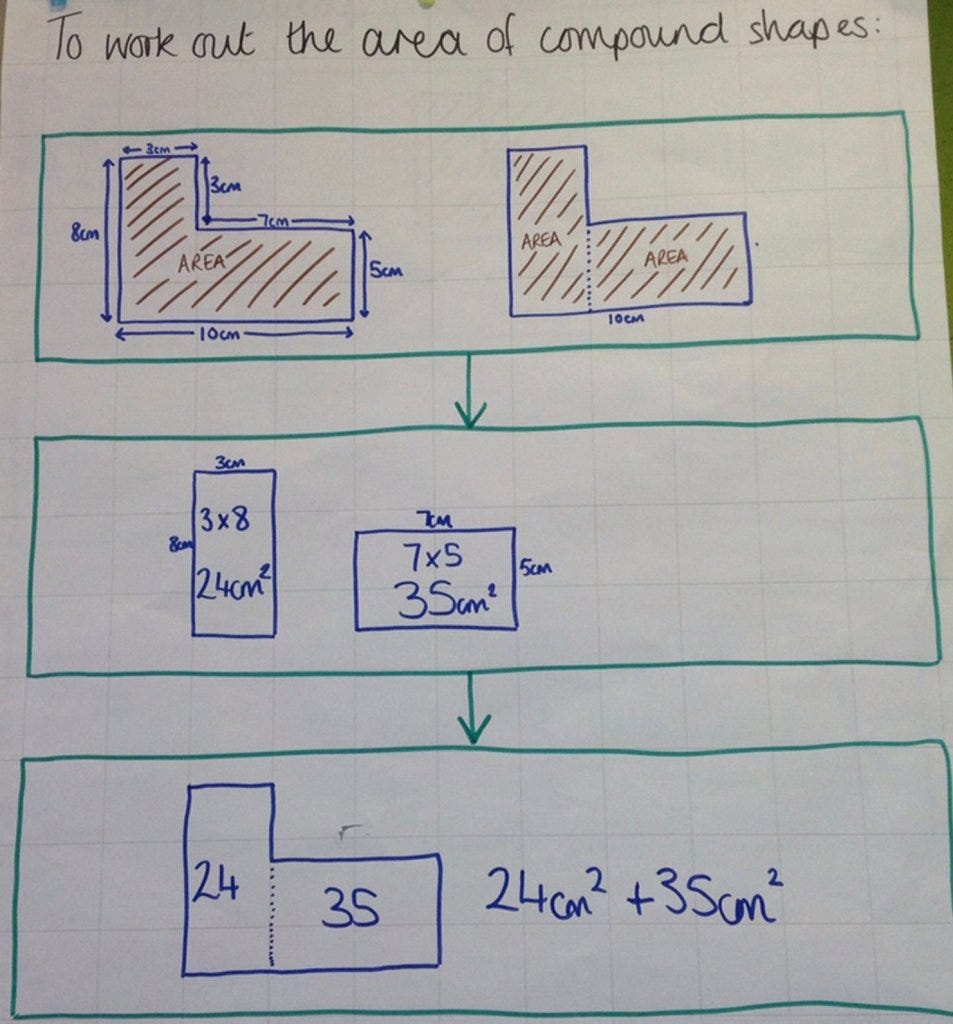
Note that these examples are not how to do a task, they are how to do the maths.
When the objective is open and success is subjective, success criteria is in the form of a toolkit. There is not one way to be successful and the choices that children make might result in stronger or weaker examples of achieving what was intended. Here’s an example for suspenseful writing:
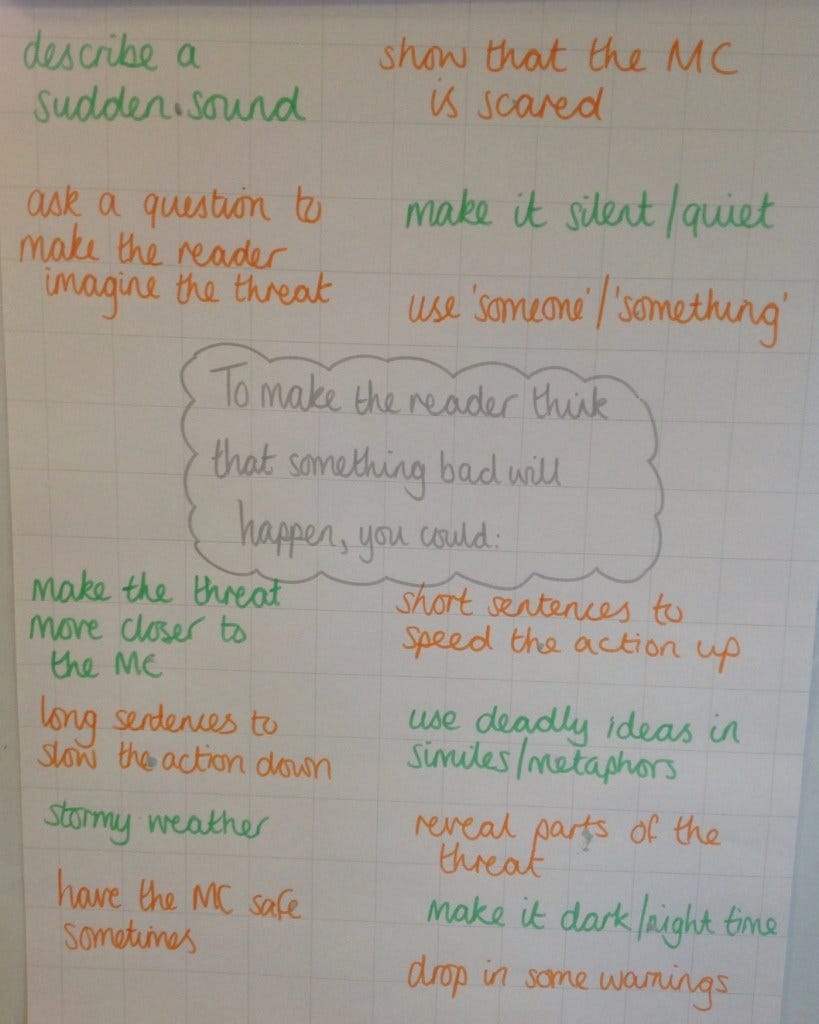
Clearly when it comes to writing, children could create suspense using all, some or even none of these criteria. This is at the heart of the Talk for Writing approach. Children here would be making choices from these criteria and more in order to create suspense. Simply ticking them off, or more commonly something like ‘using an expanded noun phrase’ does not necessarily lead to success. We might want children to use expanded noun phrase in their writing and have this as a success criterion but this is where we need to be true to the subject. Writing is about the effect on the reader, not the mechanical use of expanded noun phrases, fronted adverbial and relative clauses. Is there a place for learning these? Yes! At the heart of achieving any given effect on a reader is the readability of a text. Children can learn the closed objective of writing a grammatically accurate multi-clause sentence with a relative clause by ticking off the use of a relative pronoun, commas surrounding the relative clause etc. But when it comes to text composition, it is about authorial choice not just including the grammar foci that we’ve been teaching them. We can get them to try including some of these things by modelling, collecting ideas and celebrating examples, but they alone are not what makes writing effective. Pie Corbett puts it better:
Just as writing might have closed and open objectives, so to might maths. We might teach children a range of strategies for subtraction and these would be closed objectives. However when it comes to solving subtraction problems, at some point, we won’t dictate the strategy that they should use - they should choose. If they were presented with 4001 - 3997, they should select the strategy that is most appropriate. The tools at their disposal might be:
Counting up
Counting back
Column subtraction
Rounding and adjusting
Maths presents a very common abuse of success criteria and it goes by the name of RUCSAC.
Sharing objectives and success criteria
One of the effects of inspection is that leaders want teachers to start lessons by sharing learning objectives and success criteria. This might be useful sometimes but it might also be a terrible way to get children to understand what we want from them. A slide with an objective and a list of criteria at the beginning of a lesson could quite easily mean nothing to a group of children. Done badly, they might never be recorded anywhere and end up in the land of wind and ghosts because of the transient word effect.
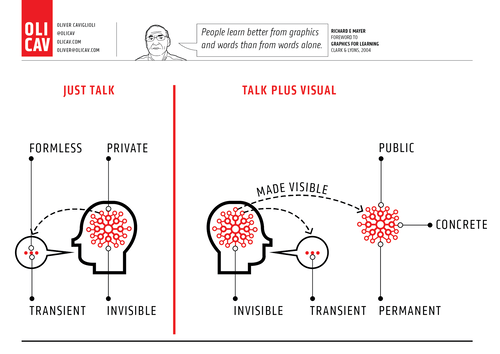
Children need examples and non examples; concrete models of what it is that we want them to think about, not abstract ideas. Co-constructing criteria by modeling a procedural step and narrating what you did, followed by shared examples can be effective. Co-constructing criteria by comparing examples of different quality and what makes them so can be effective. Sometimes our actions communicate what we want children pay attention to far more than clunkily worded objectives on a slide.
Matching the objective to the task
We might have a clear objective, decided whether it is open and closed and thought through the success criteria accordingly, mapping out a set of instructions if it requires procedural criteria and a range of options if it is an open objective. But what children then do is crucial in supporting their application of this clear thinking. It is so easy to design and set a task that it is too different from what have modelled which can lead to confusion and missed opportunities for learning. Here are some examples, all of which I have been guilty of at some point:
Modeling the opening of a story then getting children to continue from that point
Modelling how to solve a maths problem then getting children to solve problems with a wide variety of underlying structures
Modelling an explanation of a science phenomena then getting children to write an explanation themselves
Modelling sorting materials then getting children to cut and stick
We have to look at the tasks that we have chosen or designed critically - what will children be thinking about when they do this? Is this what I will have modelled? Is there any element of this task that might actually pull their thinking away from what I want them to pay attention to?
One objective, layers of challenge
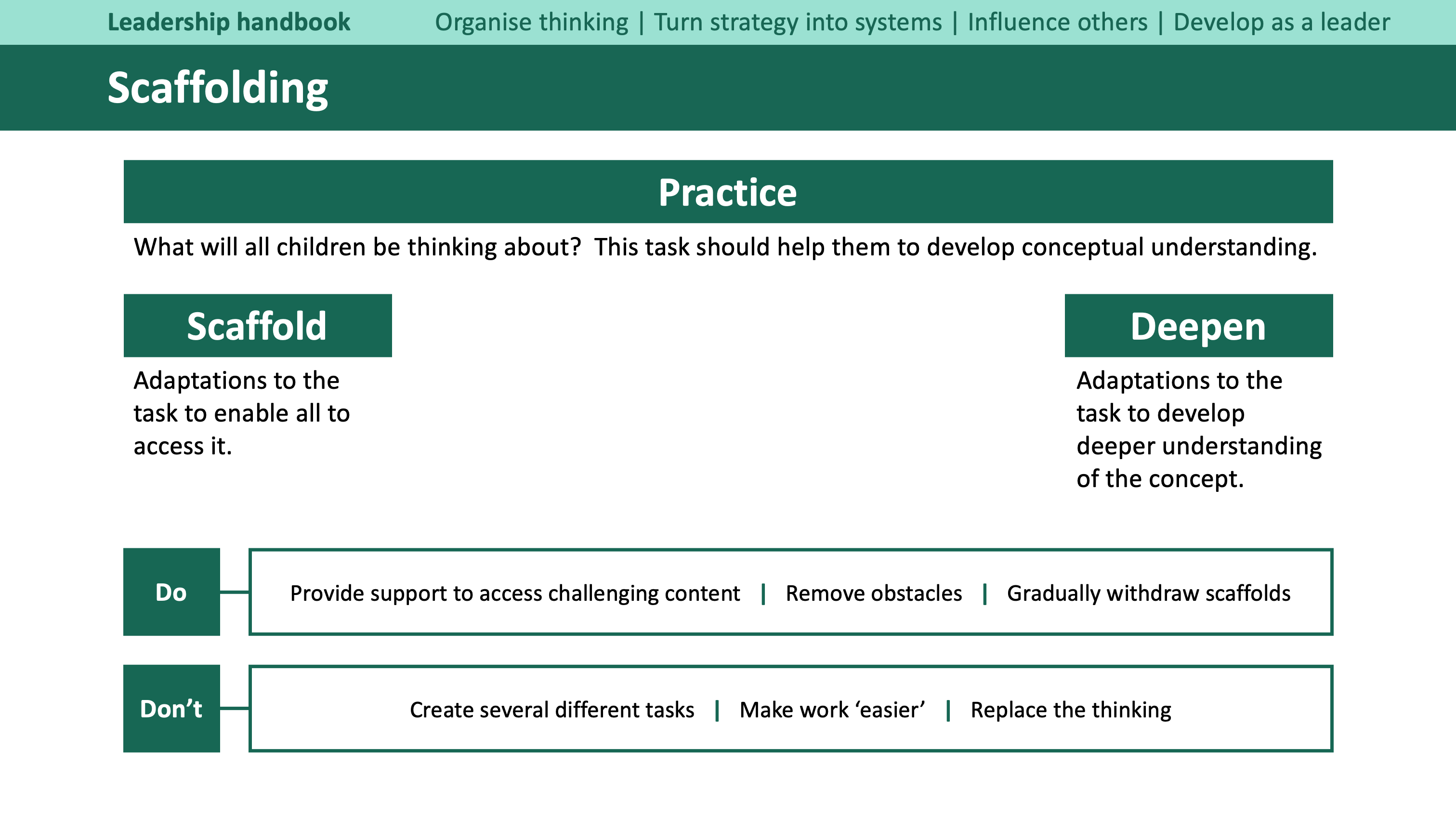
Differentiating tasks several ways is a workload nightmare. It can also manifest as several learning objectives. I remember watching a lesson many years ago where children were using a hundred square to add 9 to a number - adding 10 then taking one. Great! Accessible and clear procedural success criteria. But there were children who were ‘lower attaining’ that were simply working on forming the number 9 correctly. Now if children can’t yet do that, they need to be shown and they need to practise. But they could quite easily have accessed the learning of adding 9 because of the scaffold!
Summary
Reasons to think more deeply about learning objectives and success criteria:
Questions to ask ourselves when we’re designing lessons:
What do I want them to learn?
What task will help them to progress towards this goal?
How can I explain this to them without muddling the two?
Is it a closed or open objective?
If closed, what are the steps to success (and not simply completing the task)?
If open, what are the tools that children might select from?
How can I co-construct the success criteria with the children?
Does the task match the objective? What will they be thinking about?
How can I adapt the task to make it accessible / more challenging (without creating an entirely different task)?
Things to avoid:
Using national curriculum statements as learning objectives
Including the task in the wording of the learning objective
Creating multiple tasks
Forcing procedural success criteria on open learning objectives
And finally, success criteria for designing success criteria:
Are children going to need rules or tools? A procedure or a toolkit?
Make the criteria about the learning, not the task
Simplest language possible or picture prompts
Co-construct success criteria with children (but plan them first!)
Narrate the success criteria you want to draw their attention to while modeling
What really lands for me is your insistence on separating learning from performance. In KS3 especially, that conflation is everywhere. A student completes a task neatly, on time, and with apparent confidence — and we tell ourselves the learning objective has been “met.” But as you say, learning is cumulative, slow, and fragile. One lesson can create conditions for learning, but it can’t complete it. That reframing alone would reduce a huge amount of false certainty in our judgements.
Your questions about task-objective alignment are ones I wish were asked more often in planning meetings and lesson observations. “What will they actually be thinking about?” is such a deceptively simple but powerful test. I’ve seen countless lessons where the modelling was precise, but the task introduced extra demands — layout, volume of writing, cutting and sticking, extended independence — that quietly hijacked attention away from the intended learning.
Love this perspective! It's so true how easily we conflate performance with actual learning. The real challenge is building systems that measure sustained progress isnt it?